


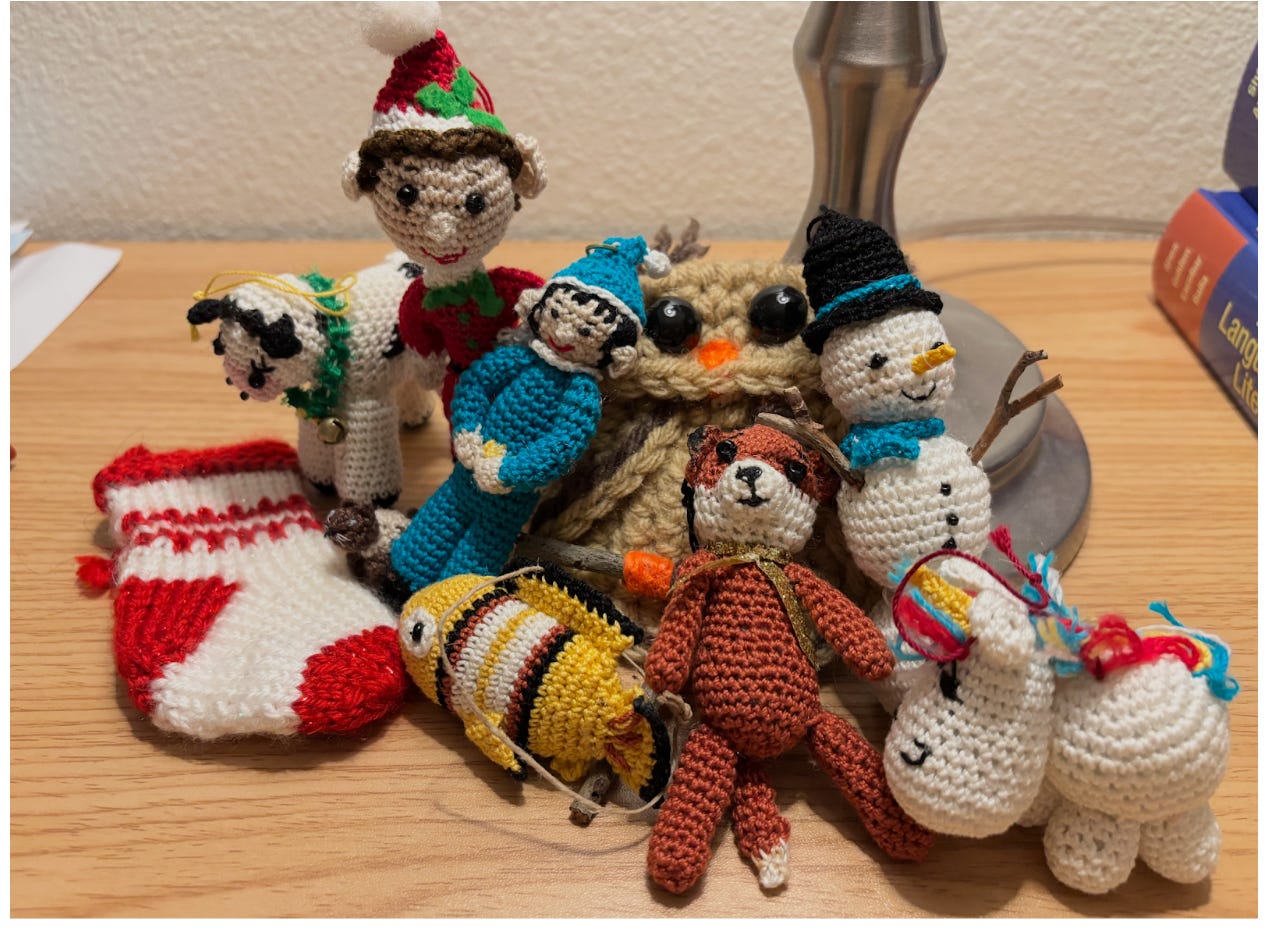
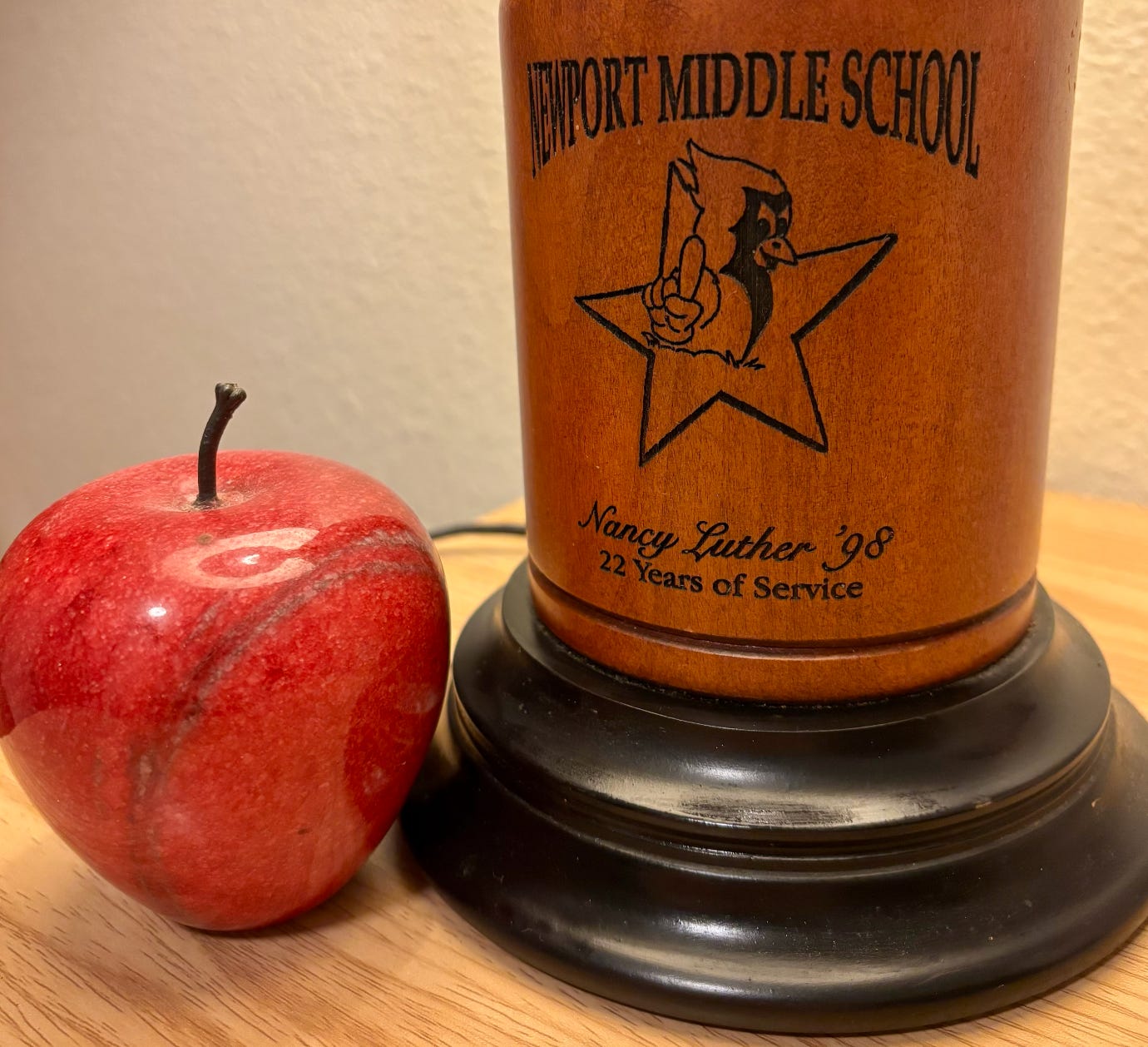
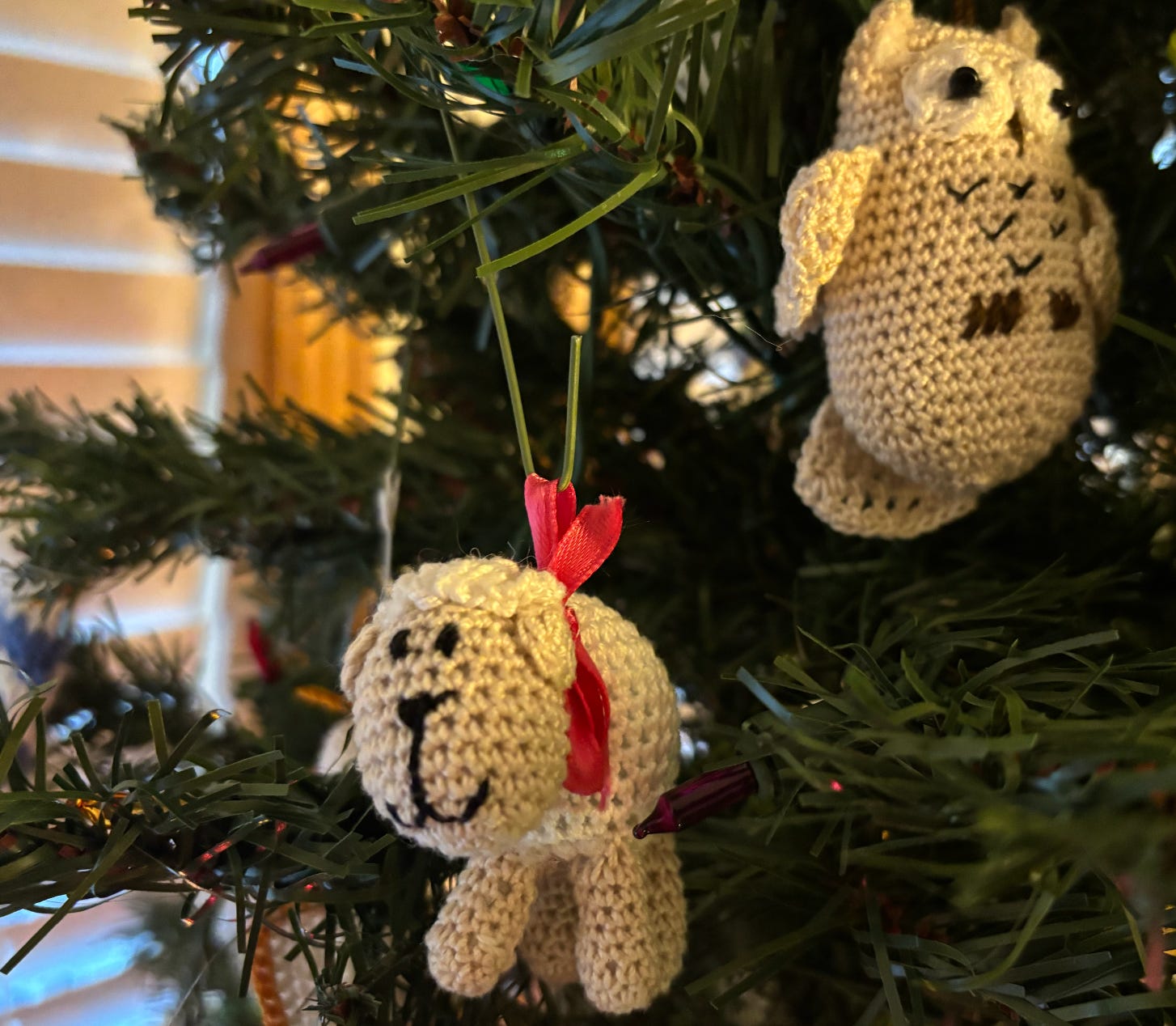
A month ago we once again went through what has become its own holiday ritual in our household: I unfold and then climb a creaky, wooden ladder into the attic above our garage, electric lantern in-hand, and carry down over-stuffed boxes of Hanukkah and Christmas supplies one at a time—including one box of hand-crocheted ornaments gifted to me from my grandmother, Nancy Luther, who passed away this past September.
Grandma Bam, to all her grandchildren.
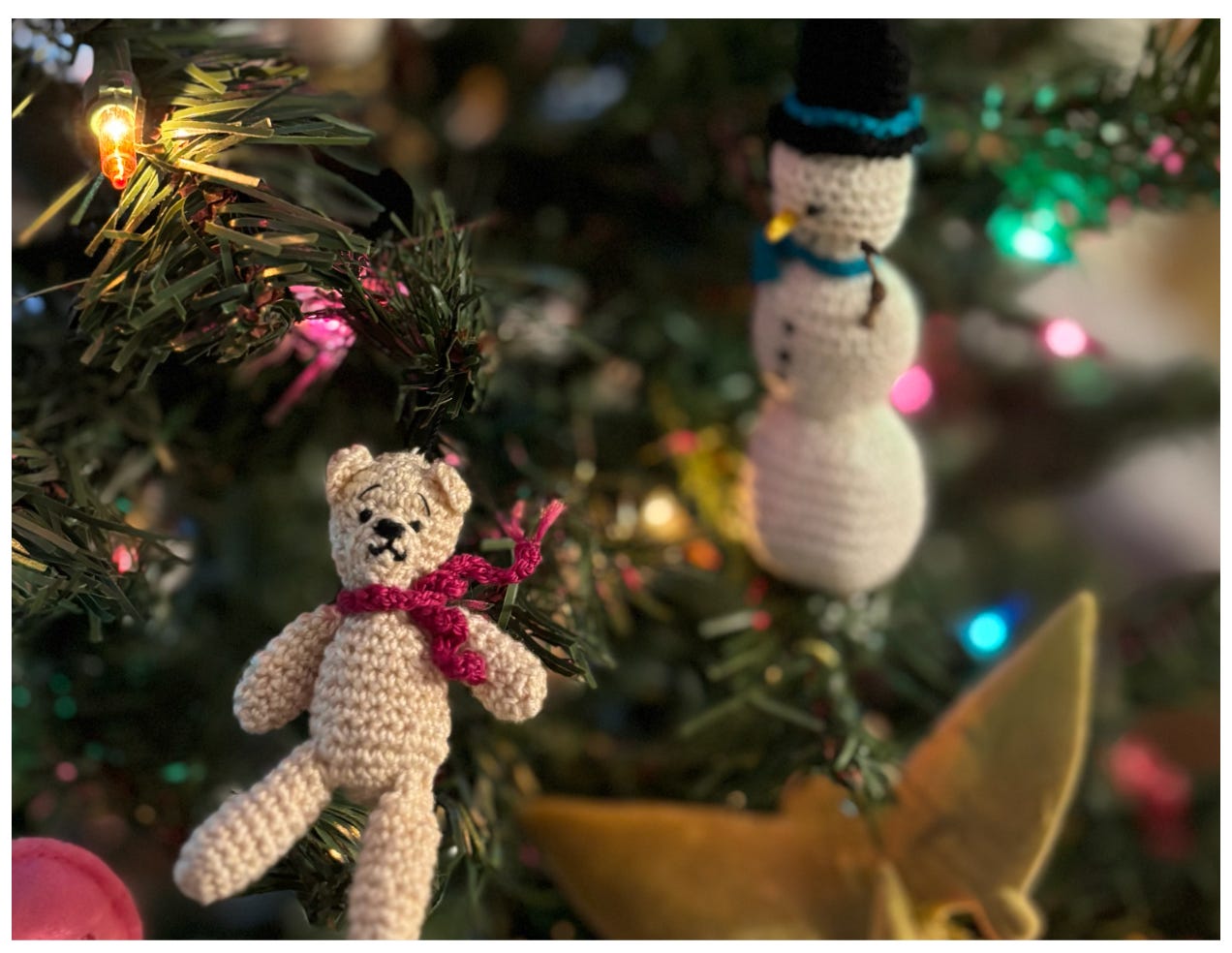
Some of these handcrafted ornaments are what you would traditionally expect for the season: a Christmas stocking, an elf, and a smiling snowman with twigs my Grandma Bam gathered from her own yard. Others are a bit more of a surprise at first, from a striped fish to a unicorn to my personal favorite: an owl that looks more than a little bewildered at the state of things around it.
After years of pitter-pattering and adventuring around Grandma Bam’s house when we were younger, once we were older and started our own families a new tradition emerged for all of us grandchildren: each Christmas, we would each receive a handful of crocheted ornaments, each uniquely sewn and wrapped—often inside single-serving breakfast cereal boxes or toilet paper rolls—to adorn the Christmas trees in our respective households.
“I like to think of all of you and your families as I’m working on them,” my grandmother once told me, as I tried to mentally calculate the hours on end it took to individually create each design of ornament for each one of her grandchildren.
An incredible devotion of time and attention that I never took for granted.
Not for a second.
Especially as a parent of a six-year-old and three-year-old, I am daily reminded of how awash the world is with plastic.
The sloshing back-and-forth of plastic Lego bricks within various plastic bins is a regular noise in our household, as is the whirring of plastic cars as the boys race to and fro; the click-clacking of plastic magnet tiles; the splashing of plastic toys that help make bath time enjoyable and—if I’m being honest, survivable.
Of course, those are just the toys. Plastics have become part of our human environment in myriad, irreversible ways—as well as part of who we are as humans. “The human body itself is part plastic,” Annie Lowery wrote in The Atlantic, noting how “researchers, wanting to examine the effect of plastics on the human body, are struggling to find all-natural individuals to use as controls in studies.”
To repeat: are struggling to find all-natural individuals to use as controls in studies.
If the environmental and health risks weren’t enough, too, there is another aspect of our plastic landscape that has been made clear to me as a parent, particularly during holiday season: the ubiquity that our plastic culture brings with it.
While at first I was a bit startled by this as a parent, I have now become quite used to the same best-selling, age-appropriate toy showing up in online photos of all of my friends—some of whom live on the other side of the country from me. Search “best bath toys for toddler” and the same colorful, affordable plastic options are presented no matter your location or circumstance, all ready to be shipped from strategically-placed warehouses the moment you click.
Through some combination of algorithm and Amazon, it seems, they have taken plastic as a material and flattened the variety our children are encountering in their various worlds.
Yet who am I to judge? Sometimes you get a birthday party invite last-minute and Amazon Prime is one click away. We’re all just doing our best.
Still, perhaps this is another reason why those crocheted ornaments from Grandma Bam create such a stark contrast amongst all the other decorations around them each Christmas season.
A meaningful contrast, too.
As a high school English teacher, I’ve spent 2025 thinking about plastic a lot lately for a different reason: the immersion of artificial intelligence into so many facets of education and our conversation around it.
From the initial panic two years ago about the end of the traditional essay and widespread student cheating to the increasing push for AI literacy amongst educators and students alike to a proliferation of educational technology tools and systems, the impact of AI throughout education has been irrefutable even as there continues to be little consensus around it.
As someone who has tried to balance skepticism with curiosity around this conversation, I remain relatively bamboozled on what the “right” path is going forward—other than to suggest, perhaps, that more than a little humility is needed by more participants in this conversation, particularly those situated outside of a classroom.
My one other conviction at this point: the value I place in the authentic words of my students has never been more considerable.
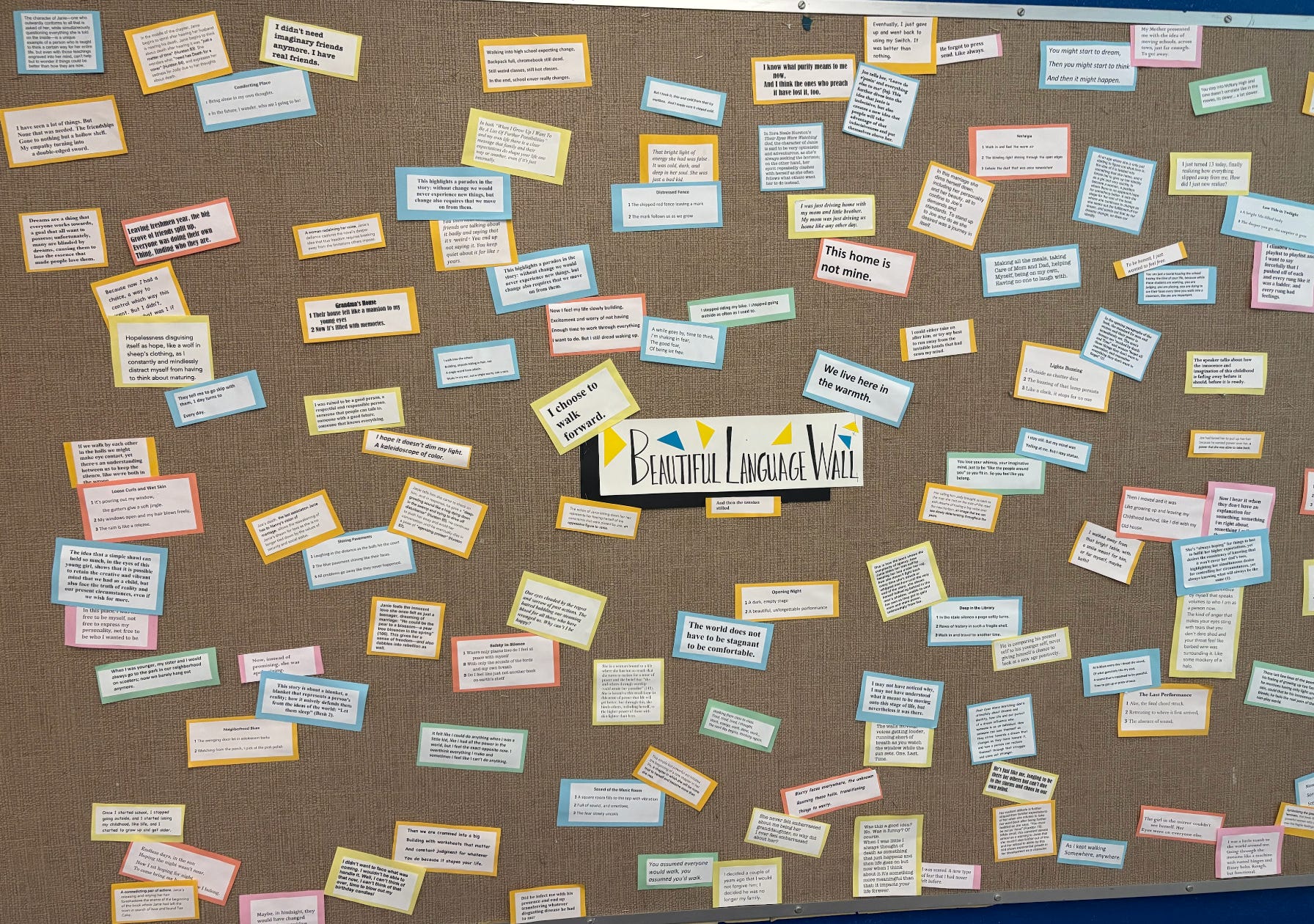
When I sit down to read the writing of students, I have a process that I have honed over the years—one that I realized while drafting this end-of-year essay mimics my grandmother’s ornament-crafting in a way. I keep a separate Google Document open whenever reading student writing and, whenever a sentence surprises or resonates with me in some sort of way, I copy it over.
Like my grandmother gathering a twig from her yard to attach to a crocheted snowman ornament months later, this is my crafting ritual: not only looking for and copying over sentences from students, but then printing them out, cutting and gluing them to different colors of paper, and then affixing them to a bulletin board that fills to the brim by the end of the year.
While there is no crocheting in this process, there is a lot of time spent as well as a lot of thinking—and the result is one of the most meaningful spaces in our classroom.
A space filled with the words of students.
Despite rituals like this, however, I still worry that—in the classroom and beyond—we are not reckoning with the new reality that lies ahead of us: a landscape increasingly filled with plastic words.
The amount of AI-generated articles on the internet now surpasses human-written articles, according to one study, but that does not even take into account the amount of “human” writing that is being at least partially aided by AI. The percentage of adults using AI at work continues to climb and a recent study of professional writers showed that a clear majority used AI. (Even within the most expectedly-resistant group, fiction authors, 42% admitted to AI use at least sometimes.)
Just like its more tangible plastic predecessors, AI has made the written word more efficient to generate than ever. As Lowery acknowledged in her article, “Plastics have also dramatically cut the cost of making and moving things, powering our modern consumer economy no less than gas and electricity have.”
Writing for The Ringer, Brian Curtis observed the impact of “The Slopification of Everything” as part of AI’s impact (wreckage?) on our culture:
…slop’s premise is that a massive output of arbitrary products, if they can be produced cheaply enough or with little enough effort, will outperform a limited supply of more carefully designed products. The ultimate condition to which slop aspires is infinite quantity produced instantly and for free.
It is not just about the quantity of these plastic words, either—but also, like the plastic toys at the top of the Amazon algorithm, their ubiquity.
Though the AI em dash hysteria has died down somewhat, I’d argue that it is undeniable that the increasing influence of AI across human writing is trending it towards conformity.
The result? Not just more words, but more words that sound the same.
Indeed, sometimes words are all that we have left.
In what I imagine is quickly becoming a type of 21st century ritual after the passing of a loved one, I found myself turning to digital memories in the months since my grandmother passed.
The unrequested Facebook memories that pop up as notifications discordantly, of course, and pictures that I have saved on my own devices—but also my grandmother’s words, reading her emails that we used to send back and forth to each other, especially in the years after I graduated and moved across the country to begin my teaching career.
In those early days of teaching I kept a Tumblr blog to document my experiences, writing words and posting them online for the world to read but really, if I was being honest, knowing that only a select few family members would actually read them.
My grandmother—a retired teacher herself—was faithfully one of those Tumblr blog readers:
Just read your tumblr blog (if that is the correct term) and saw the beautiful artwork you have tacked up but not framed. You have lots of woodworking family and should ask someone to build you a few frames as the art is definitely worth protecting. — September, 2012
Digital words, yes, but words—words sent from two time zones away with the caring reminder to take care of the artwork around me. In that same email, she had then explained how she had not been able to make it to my cousin’s latest game because of a prescription change that, in her words, left her “feeling a bit puny” before ending with her reliable closing: “Think of you often. Love you lots..”
Going back through these emails, there were the bowling updates (My average is suffering as my knuckles are getting misshapen and don’t fit in the ball like they did — September 2017) and birthday wishes (Hi and happy birthday in 40 minutes… — August 2019) and encouragements with grandmotherly advice sprinkled in (Now to find a place to live that works for a growing family that is safe, secure and reasonably priced — April 2020).
These were not just words, I recognize, reading back through them. These email exchanges were times we thought of each other and then spent the time to craft words for each other. Even when I was still two time zones away, teaching in Arkansas while she was thinking of me from Oregon.
“Think of you often. Love you lots..”
Talk about art worth protecting, right?
Maybe you only see the enormity of the change when you’re not a part of it.
—Zadie Smith, “Some Notes on Mediated Time”
Which leads me to the real kicker, I think, with this “plastic word” phenomenon: the empty feeling one gets when they realize they are reading words that someone did not invest the time to actually write themselves.
Within this new AI paradigm shift that we have all been drafted into, willingly and unwillingly, almost all of us at this point have had the experience of reading an email or letter and feeling that tinge of a letdown, that disappointment in recognizing that the words in front of us were not a priority for whoever crafted them. Or even worse, that more-than-a-tinge-of-a-letdown as a teacher when you encounter a student’s writing, with hope and generosity, and realize that it is not, in fact, a student’s writing after all.
Right now these experiences are still the outlier, I think, but what happens when this type of letdown becomes a given? When we read an email from a friend? When we leave feedback on student writing? When we seek out a journal article? When we open up a book?
As the remarkable Zadie Smith noted in one of her essays in the new collection Dead and Alive, “the enormity of change” is difficult to discern when you are living through it.
For me? I feel like I cannot not see this drift towards plastic words happening—and as a result cannot stop thinking about it.
I think about this as a grandson who found himself turning back to those emails from his late grandmother, knowing how much meaning was invested in every one of them, and never having to question the meaning behind them.
I think about this as an English teacher, too, trying to do everything I can to help foster a love of reading and writing—while reckoning with the reality that children and adults are already reading less and, when they write, potentially doing so less authentically.
I think about this as a father who wants his children to be able to escape into the world of books in the same way I did as a child—but knows that the temptations of distraction have never been more considerable. Who wants them to understand not just the value but the magic in crafting their own words, rather than outsourcing that capacity elsewhere.
I think about this as someone who thinks of reading and writing as essential to not just my own work but my own identity. Even typing this sentence I have stared at the blinking cursor for several moments, deleted and retyped and then deleted and retyped again, all with the belief that the shape and sequence of the words matter. To this piece of writing but also to me, the writer, in the process of crafting.
What will happen when the words we encounter increasingly become plastic?
This is the wondering I have carried throughout 2025 and continues to be an anxiety for me going into 2026. That in our already trust-depleted society, our trust in the authenticity of words—and the time invested in their crafting—is going to further erode. The letdowns we experience in encountering plastic words will become the letdowns we anticipate, an anticipation which may redefine not just reading and writing but communication and culture and, consequently, all of us.
More quantity, less quality. More ubiquity, less authenticity.
More and more, less and less.
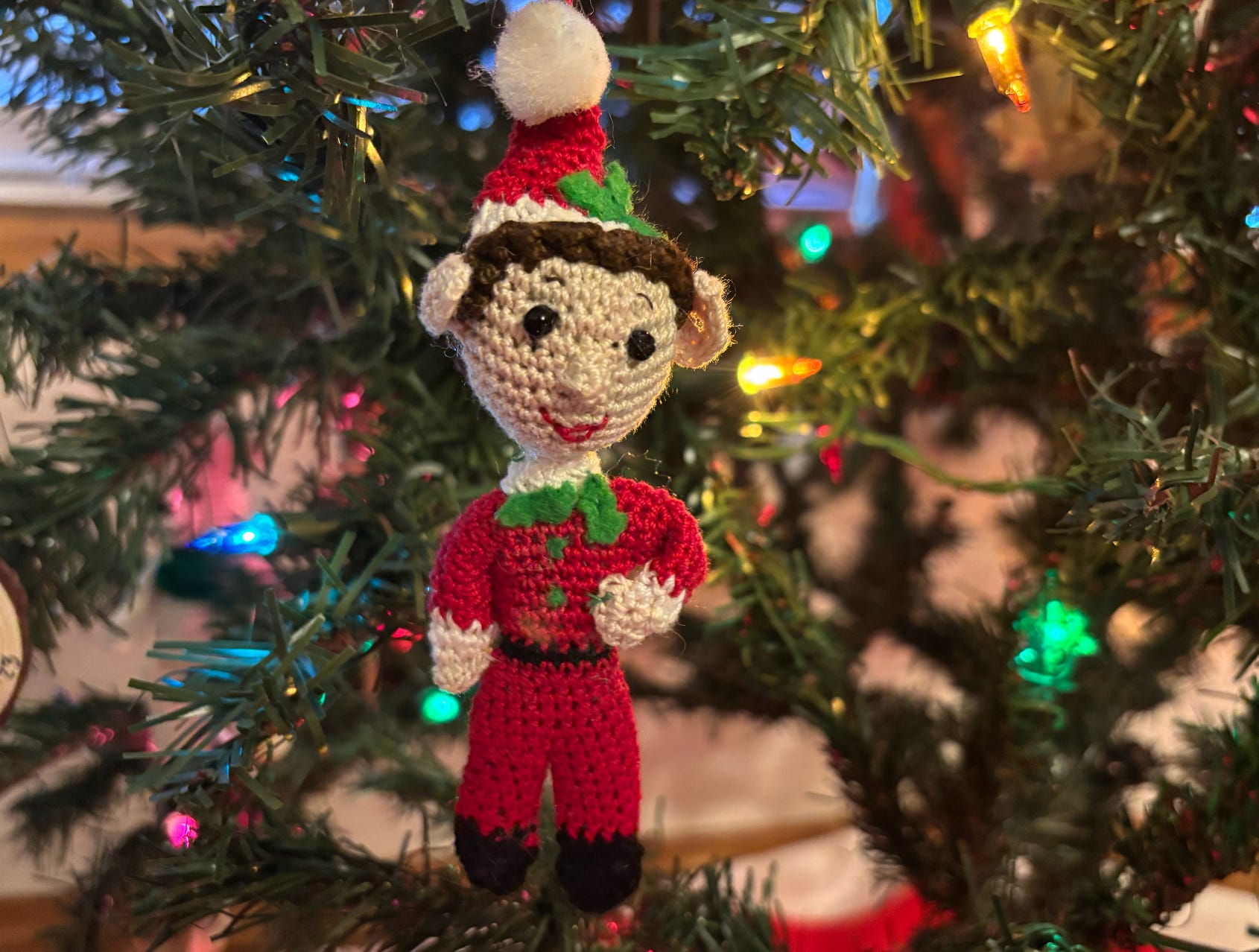
As holiday season comes to a close, we will soon box up our hand-crocheted ornaments from Grandma Bam once again—with the knowledge that going forward there will be no additional Grandma Bam ornaments to add to our collection.
We must make do with and cherish what we already have.
Taking down each individual ornament (from our conveniently-fake plastic Christmas tree, I must admit) I will think about the time that my grandmother invested into crafting each and every one of these ornaments. I will think about her thinking about us as she stitched the scarf on the teddy bear and added the twig arms to the snowman. I will think about what it means to “feel puny” and how fortunate I am to have had a grandmother who I knew, without a shadow of a doubt, was thinking of her grandchildren often, always from a place of love.
No plastic at all in a world filled to the brim with plastic.
I know that there are many worthwhile things to think about as 2025 ends and 2026 begins, in education and beyond. Ramifications and immediacies around AI’s intersection with our work and world, and thoughtful, diverse perspectives on this and many other topics.
I do not presume to have an answer. Or even a semblance of one.
But I do worry that we are not taking seriously what it will mean to be increasingly surrounded by emptier, more-ubiquitous words along with, consequently, what I see as the inevitable expectation and normalization of emptier, more-ubiquitous words in how we move through the world.
We already know that plastic in our world has changed our world—and changed who we are within it.
Won’t plastic words do the same? And if so, what will that mean?
A closing note (and recommendations)
As this will be the final post of 2025, I wanted to briefly thank all of you who have read and shared and responded to The Broken Copier the past year—and really, since the beginning of this project.
An update (that I’ll expand on in a final, brief podcast of 2025 next week): there won’t be as much content coming out over the next few months. An occasional post or conversation might pop up from time to time, but one of my own goals is to prioritize my learning and reflection even more in 2026—which at times can be interrupted by trying to keep up with a schedule of sharing a post or conversation each week.
The good thing? I continue to be both encouraged and humbled by the many, many thoughtful voices in this space—and, as has become a welcome new tradition here, I wanted to end this post by sharing three pieces that meant a lot to me recently:
Something to read: “AI Conversations Behind Closed Doors” by Stephen Fitzpatrick — Fitzpatrick emerged, in my mind, as one of the most enlightening voices in 2025 around the intersection of AI and the classroom, and this piece underscores so much of why I value his approach to this topic. Fitzpatrick leans on the voices and views of students here, and if nothing else in 2026 I hope more take a page from Stephen in centering the perspectives of those this whole education thing is supposedly about.
Something to listen to: “Crash Course Social Studies Education w/ Raoul Meyer” by The Human Restoration Project — If you’ve ever watched a Crash Course video by John Green, I think this will pique your interest, as it did mine. But within that interest-piquing, this conversation avails a really important conversation about history itself in our current educational moment—and particularly how teachers can and should approach it in their classrooms. (Another reminder, too, that The Human Restoration Project continues to do so much incredible work!)
Something to explore: “AI Isn’t the Main Problem—It Just Shows Us What That Problem Is” by Tyler Rablin at Edutopia — I think my only quibble here is that the title is a tad distracting, as the value of this piece are the actual assessment strategies Tyler offers that could be used in many different classroom contexts. If you’re like me, you will read this piece as a classroom teacher and immediately begin imagining forward about what this could look like in your own space—which, in my mind, makes for the best type of resource to explore.
(Also worth noting: we were fortunate but also proud to have Stephen, Nick, and Tyler on The Broken Copier as guests in 2025!)
Terrific essay, Marcus.
Thank you for sharing something real in a very plastic-words age we are inside.
Real will triumph of that I have no doubt; but we are driving in fog. And one thing I know when driving through fog is: keep going, slow.
I love everything about this piece; from the personal story of your grandmother woven through to the plastic metaphor of AI. I’m bookmarking this to read again and again!