
Keeping Discussions Going, Pt. 1
small moves that I lean on to extend and deepen whole-class discussions


“Draw, you rogue!” a student shouts at me from the front of our classroom, “for though it be night, yet the moon shines. I’ll make a sop o’ th’ moonshine of you, you whoreson, cullionly barbermonger. Draw!”
Yes—if you’re wondering: the rest of the classroom was somewhat aghast at such commentary being directed from a student towards a teacher!
Thankfully, this student was just reading their assigned lines as the ever-loyal, always-combustible Kent in King Lear—while I played his nemesis: the scoundrel Oswald.
I typically take a part in our whole-class readings of any play in order to interject notes of commentary, such as directing students to look up the in-text note for cullionly barbermonger—“despicable fop,” if you’re curious!—and also to pause at times to offer character motivations for more-reluctant performers.
This student, though? They already were quite inspired with indignation at me, I’ll admit, as just minutes earlier they had shouted out mid-discussion without any lines to read from:
“Not another false choice, Mr. Luther!” they yelled, hands raised towards the ceiling. “It’s always either THIS or THAT with you! Nothing is that simple!”
My response? A simple shoulder shrug and knowing smirk.
“That’s why we have our essay to look forward to later this unit.”
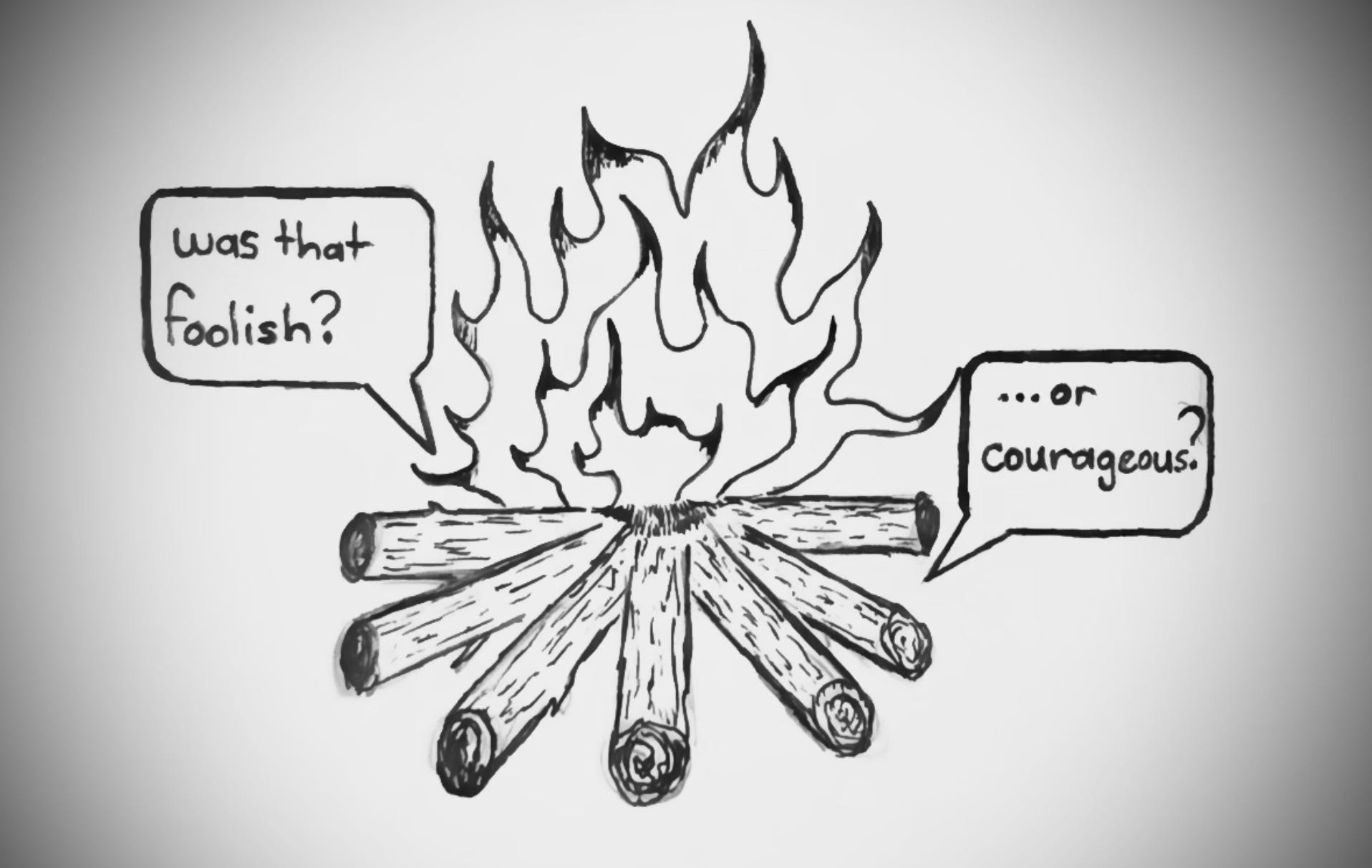
Moves to Keep Classroom Discussions Going
Particularly with denser texts like Shakespeare during the dreary, cough-ridden months of winter, keeping the energy of the room going can be a bit of a challenge.
However, despite me having flown a red-eye flight the previous night and with students distracted on myriad fronts by the forthcoming Valentine’s Day, the conversation in our classroom remained aflame throughout the period as we moved through Act 2 of King Lear across a ninety-minute class period.
There are many reasons for this—first and foremost the generosity and enthusiasm of this group of juniors I’ve had the privilege to work with this year!—but one of those reasons, I think, is that I’m at a much better place as a teacher in Year 14 at not only initiating discussions but even more so building momentum to extend and deepen them through the class period.
While I’ve written before about different discussion-starting “moves” I lean upon in quieter classes, especially at the beginning of the year, it is an altogether different tool belt as a teacher to take the initial responses of a whole-class discussion and, like coaxing and coaching the embers of a fire, to build the energy to the point that the discussion becomes self-sustaining.
In this post I’m going to share three different strategies I use within whole-class conversations to keep them going and, in doing so, strengthening the culture of academic conversation in our classroom. (My plan is to then follow up with more next week, too, so feel free to add your own suggestions and feedback in the comments!)
Move ⓵ — Toss out a false dichotomy
I fully admit to loving this logical fallacy move as a facilitator of conversation in the classroom—even if certain students (see above) may get irritated from time to time by it. At this point in my classroom students are very much used to being offered an either/or framing, as I have learned that such a pivot within a conversation can help move it forward in myriad ways.
An Example of This Move: In our discussion of Act 1, Scene 3 of King Lear during a previous lesson, students were intrigued by Kent’s choice to return to loyal service of Lear in disguise after having just been banished in the opening scene for speaking up against the king’s errant judgment.
“Alright everyone, let’s decide,” I ask, grabbing hold of the discussion. “Is Kent’s choice to return and serve Lear despite the threat of death an act of courage or an act of foolishness?”
Students debated briefly in groups before sharing their answers out whole-class—leading to further elaborations and more importantly scrutiny in regards to what each student’s definition of loyalty actually was.
Why I Love This Move: at its best, this sort of acts as a win-win within the layers of a classroom discussion: [1] it allows for you as a discussion facilitator to narrow and clarify a main point into a straightforward framing, which supports students who may be struggling to track the nuances of the conversation taking place; simultaneously, [2] it creates a simplistic framing that your higher-level students can resist against, with that resistance itself serving as a form of elevated rigor.
Tips for Using This Move:
There are easy framings you can always use (thumbs up, sideways, or down? agree or disagree?) in almost any conversation, if you’re on the look out for them
Tossing it back to groups to discuss and vote allows for every student to take part in the conversation while also offering a break from whole-class conversation
In following up on student responses, I have found that it can be helpful to guide students towards more nuance than the initial framing (while also explicitly acknowledging how the framing itself is intentionally simplistic)
Move ⓶ — Have students vote with their feet
As a teacher who is always on the look out for opportunities to get students out of their desks within the lesson, this is another go-to—especially in the middle of a discussion, as a bit of actual out-of-seat movement can be the needed ingredient to keep the broader conversation going.
An Example of This Move: Having just witnessed the character Edmund escape his status as the illegitimate brother by framing his unknowing brother Edgar to begin Act 2 of King Lear, leading to Edgar’s flight and Edmund ascension to the status of “natural” son, I sensed that the opinions in the classroom were all over the place as far as Edmund’s actions as a character.
“Everyone jot down a number between 1 and 7,” I say, interrupting the conversation. “The higher the number, the more you are a fan of what Edmund is doing. Trust your first instinct!”
Instead of discussing their answers in groups, though, I have students then line up without speaking at all across the room—one wall of the room being where 7’s stand and the opposite being where 1’s stand—allowing students to see where their classmates stand (literally) before they debrief their reasoning with someone standing near them.
Why I Love This Move: I think of this strategy as tossing another log on the fire—even though the flame might dance or even dampen a bit, the added log (in this case, the opportunity to get up and move around the classroom) can breathe a second life into the discussion—and often times it is within that second life that the really important insights get shared from students, I’ve found.
Tips For Using This Move:
Having them write down their number/position before standing up helps a bit with the “peer pressure” drift in this type of activity—especially if you pair that with them bringing their written answer to share with others
“Four corners” is another potential out-of-seat move, depending on the question framing (particularly if students are choosing between options)
Class size is always a factor here, as with smaller classes we may continue the discussion standing whereas in my larger classes we usually return to desks before diving back in
Move ⓷ — Pivot to a quick write
This may seem counterintuitive, but one of the best “moves” I’ve found as a teacher in facilitating discussions is recognizing when students need to pause and get a thinking “recharge” by briefly jotting down their thoughts in writing. Almost akin to shielding a fire against breezy surroundings, sometimes momentary silence is the ingredient that sparks a discussion to a better, deeper place.
An Example of This Move: Within our discussion about Kent’s loyalty in the opening scene of the play, in one class a student noted how, in their opinion, loyalty should only extend so far as someone is willing to be loyal in return. Another student, though, pointed out that loyalty is about staying with someone especially when they’re struggling.
This is the moment, I realize: “Pause, everyone. Write down your own definition of loyalty, including any limitations it should have. Go.”
A stretch of silence settles while students return to their spiral notebooks briefly—some immediately scribbling away with others sitting in deep thought. How do you define loyalty? Eventually, everyone is writing and then, once done, deliberating in groups—and from there the whole-class discussion is rekindled, taking on a new life.
Why I Love This Move: Yes, this means interrupting the discussion—but even in a pretty-active discussion you likely only are getting ten students at most jumping in; however, when you pivot to writing mid-discussion, every pencil in the classroom starts scribbling and those puzzled looks start forming when students try to write out their thoughts.
Tips For Using This Move:
If you have a system like spiral notebooks already alive and well in your classroom, this is an easy pivot; if not, you need to make sure your students are ready and equipped to do this seamlessly going into the discussion (index cards, sticky notes, etc. can work well for this!)
Depending on what level of students you’re working with, voicing aloud a sentence-starter can be a really helpful scaffold to get students going (example: “In my opinion, loyalty should be…”)
The pivotal part of this move is what you do after it—whether debriefing in small groups or even shifting to an out-of-seat debrief (4 corners, find a partner in a different group, etc.)
Across These Moves: Responding to the Vibe
Reflecting on my own mindset around classroom conversations over my career, I think I’ve too often placed emphasis on the initial stages—particularly around strategies to get students speaking up in the first place.
This matters, yet I think the true difference classroom-to-classroom is not necessarily how a teacher begins whole-class conversations but rather how they continue them.
Indeed, beyond specific “moves” as a conversation facilitator, I believe it all hinges upon monitoring and responding to the vibe of the classroom throughout the conversation with attention and intention.
This is tricky, though! It requires you to simultaneously be thoughtful and responsive to individual student comments as a teacher while also paying attention to how others in the classroom are staying engaged and the overall energy of the room.
The difficulty of this type of facilitation, though, only underscores its importance, I’d offer—which is one of the reason I so enjoyed talking to both Matthew R. Kay and Joe Ferraro this past summer on this topic. (Both have phenomenal resources around dialogue and conversation in the classroom and beyond it, too, if you’re looking to explore further!)
And even while I feel like this has been a fantastic year of conversation in our classroom—despite the occasional, mildly-irritated student calling me a cullionly barbermonger!—I never want to stop learning how I can further sharpen my own skills and find new ways to extend and elevate the conversations already happening.
As Rod J. Naquin eloquently put it in his piece this past week, “If being is dialogue, then a school only truly exists as long as the conversation continues.”
After all, it’s not just about starting a conversation in our classroom; rather, it’s about the more-difficult work of keeping it going, and authentically facilitating it to a better place.
Next Week: Keeping Discussions Going, Pt. 2
So while, yes, all of this is a matter of technique and capacity as a teacher, it is also a matter of priority—and that is why I plan on coming back next week with several other “moves” of a different sort (including some trickier conversational needles to thread).
Knowing that I’ll be circling back to this topic again in a week, before signing off I did want to end by asking a question to readers: what has worked for you with conversations in the classroom?
Do you have any “moves” that work in your own space or context?
How do you feel about the value of whole-class conversation overall?
In recent years, have you noticed any shifts in this value—including its intersection with technology?
Feel free to respond in the comments, to email a direct response to the thebrokencopier@gmail.com, or to leave audio feedback at our Fanlist—as I’d love to feature and respond to some comments in next week’s piece, if possible.
Given that this is a conversation about conversation, let’s keep chatting!
Love all these suggestions which I've used in history class. Vote with your feet about what President Jackson coulda/shoulda done re: the Cherokees.
And the writing piece is SO important to give all students the time to think before talking. Helpful for the shyer students. You can also walk around the room and read that shy kid's awesome answer and then ask her to read what she wrote to the class. Students can listen better, too, because they're not trying to remember what they want to say--it's already written down.
Having students write down their number before “voting with their feet” is indeed key! Otherwise my students just follow their friends around.