


Confession: I do not teach at MIT.
Very few of us do, of course. I’m a teacher at a quite-large public high school in Oregon (just under 2000 students) and, beyond time zone differences, MIT feels very far away.
I note this because I do struggle at times when the decisions of elite, quite-selective schools drive discourse in education—from Alpha School’s personalized AI tutoring program to Harvard faculty’s capping of A’s to the University of Michigan’s movement towards pass/fail grade reporting for its incoming class of freshmen. Yet this is sort of how it works, which is why Harvard and Michigan, for example, became the entry point for a fantastic conversation on grading policy with Susan Blum earlier this week.
These are the terms, I guess?
The good thing, though, is that every once in awhile one of these elite, quite-selective schools leverage their resources and offer something that can be beneficial for all of us to sit with and consider—even those of us teaching in quite-large public high schools three time zones away.
Today I want to write about one of those good things: “MIT’s Ad Hoc Committee on AI Use in Teaching, Learning, and Research Training’s final report” which was recently shared out.
I found a lot of value in reading through it, and wanted to share several things that stood out to me as meaningful to me as I think forward towards how we are going to navigate the ongoing moment that is AI’s collision with education and beyond.
A Meaningful Articulation of the Current Landscape
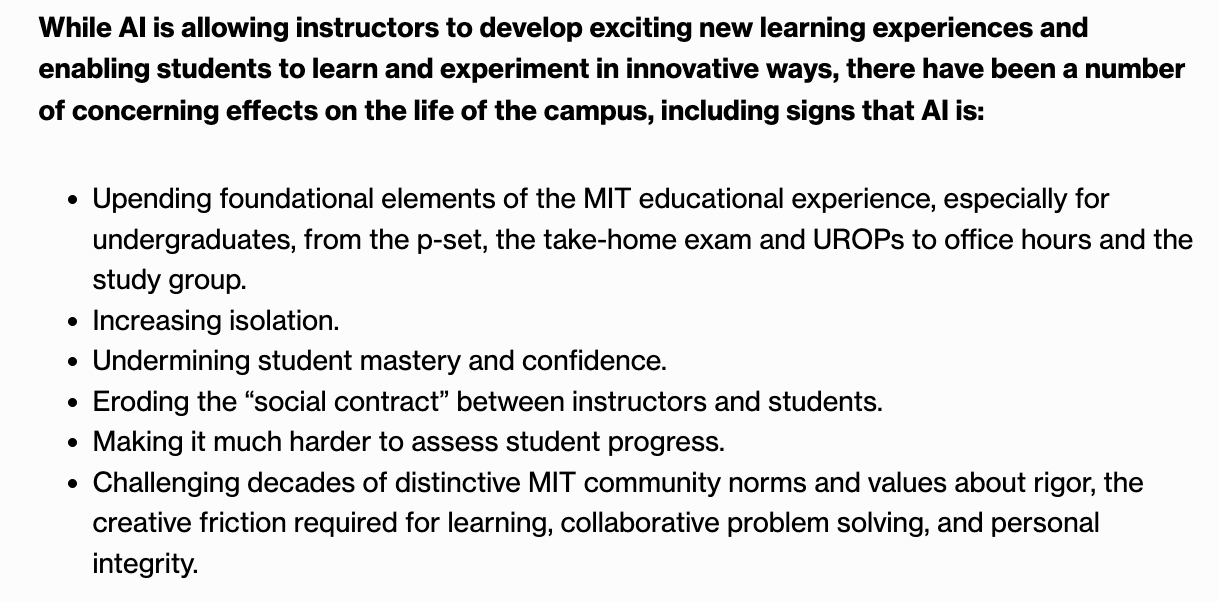
While this part of the report was attempting to describe the particular landscape of AI at MIT, so much of this list immediately resonated with my own experience over the past few years as AI has normalized itself in myriad ways across education.
My guess is I’m not alone.
The list includes very-real challenges around student learning (“Undermining student mastery and confidence” and “Making it much harder to assess student progress”), which is to be expected, but importantly includes other challenges that haven’t been adequately acknowledged, in my view, across the broader AI conversation:
The way structures we have relied upon in education have been “upended”—leaving educators scrambling to respond with little support or resources.
The fraying trust between students and teachers—in both directions!—that is precarious in an education system where trust is already too often a scarcity.
“Increasing isolation”—which fits cleanly into so much of a wider societal conversation about the human experience in recent decades, right?
And then that final point:
Challenging decades of distinctive MIT community norms and values about rigor, the creative friction required for learning, collaborative problem solving, and personal integrity.
If nothing else, I feel like this gets to how holistic this AI interruption has been—and how it has demanded, importantly, that we avoid the trap of being too myopic in how respond.
It touches everything, so we must consider everything.
At MIT and everywhere else, too.
A Principle-Driven Approach That Holds Complexity
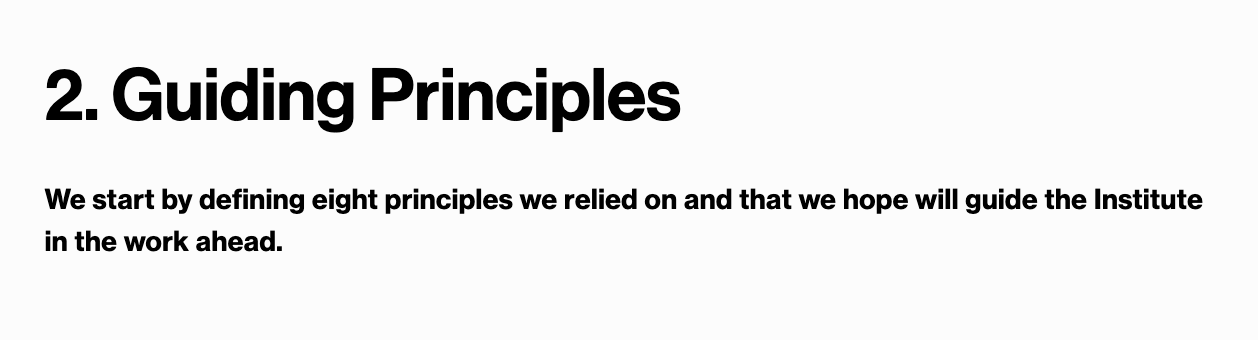
In this report, there is a rather-extensive list of guiding principles provided before any specific responses are recommended.
The eight principles that the committee offers as driving the report: [1] Be humble; [2] Be bold; [3] Put humanity at the center; [4] Lean into learning; [5] Teach with intentionality; [6] No one size fits alls; [7] Augmentation not automation; and [8] Think beyond the classroom and the campus.
If you’re just scrolling through the report, I think this particular section of the report is worth reading more closely for anyone in education.
Some of it is what you would expect and have likely seen elsewhere, such as the emphasis on learning and the acknowledgment that there is likely no singular policy or set of expectations that will meet this moment. Yet even in phrases that are almost cliche at this point such as “Put humanity at the center,” they offer a clear-cut example of what this principle could look like in action (emph:
In a listening session with instructors, we learned that some were considering using AI agents as research assistants instead of hiring undergraduates as UROPs. One can see the case for speed and efficient use of resources (especially now, when research resources are so constrained). But if those criteria come to dominate our decisions, we all have to ask, “What is it that we are here together to do?”
As a community, we need to keep in mind that although research is central to MIT’s mission, it’s more than an end in itself; on our campus, research is also an apprenticeship, a means of training the next generation of researchers to continue our work and drive our fields of inquiry forward. Using research as an opportunity for learning-by-doing may produce seeming “inefficiencies,” but that’s a feature, not a bug. (Emphasis mine)
Examples like this are important, I believe, when laying out principles in our work—and this report models a practice of principle-plus-example that many of us could benefit from in our own spaces and communities, even beyond AI.
Along with this, I think it’s just as important to note how emphatically this report did not try to collapse contradictions into empty simplifications. “Be humble” was followed by “Be bold,” after all, and later in the report this mic-drop of a line showed up:
We believe the circumstances call for a substantial reshaping of the student experience. While the life of an MIT student will no doubt look different in 10 or 15 years, as a community we have a responsibility to make sure that it remains immediately recognizable as an MIT experience. Paradoxically, preserving what’s most important will require deliberate change.
“Paradoxically, preserving what’s most important will require deliberate change.”
Talk about holding complexity with clarity, right?
Naming and Responding to AI Concerns and Critiques
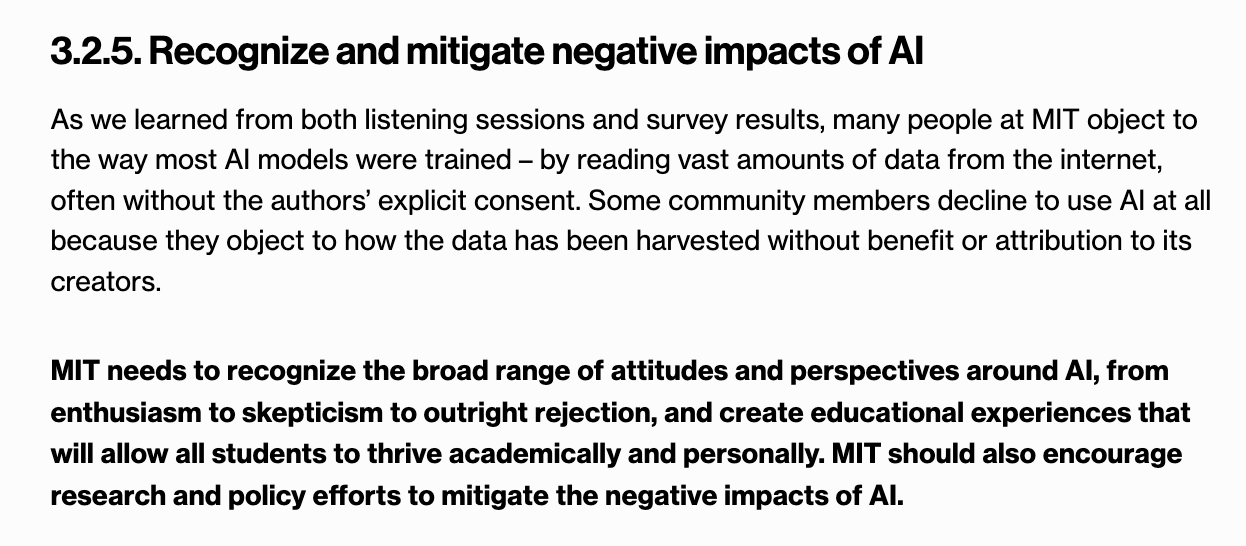
Rather than just speeding past critiques, this report spends time outlining each potential issue and offering suggested responses for each. The concerns that the report spends time with include the following:
Inequitable Access to Quality AI Tools/Models: “Some students can thus access tools that can complete substantial course projects or solve very difficult math and coding exercises overnight; others must make do with less advanced models, even if course policy allows unrestricted AI use. This imbalance has the potential to create enormous disparities in course performance.” (The report also names how this imbalance impacts educators at MIT, too.)
Data Privacy Concerns: “Today, members of the MIT community share information with AI systems that includes the most personal and sensitive aspects of their identity and experience, posing questions about their health, relationships, emotional lives, goals, aspirations, and anxieties.”
Costs and Environmental Impact: “Both training and inference incur energy costs, and the rapid response of models, as well as the constant churn of training newer and more powerful models, has an environmental impact. MIT should address this both through campus practice and through research.”
Also worth noting: for these and other concerns listed in the report, there are suggested action steps to address these. Compared to other pieces on AI in education that frequently just name the concerns without establishing any intention to address them, MIT’s report honors these thoughtful critiques and concerns by allocating substantial space within the report for them—including what it calls for as a response.
I think any teacher or school looking to move forward with AI needs to take a page from this approach from MIT, especially as students might be increasingly opposed to its usage. Addressing concerns about AI in a way that shows how seriously you take them does not automatically solve those concerns, of course, but it is a logical and necessary first step in whatever path we are going to take.
Remembering That People Need To Learn With People
With the beginning of school on the nearest of horizons for me, I was honestly planning on taking a week off from a Broken Copier post this week—but when I got to this particular section of MIT’s report I felt motivated to type up this reflection.
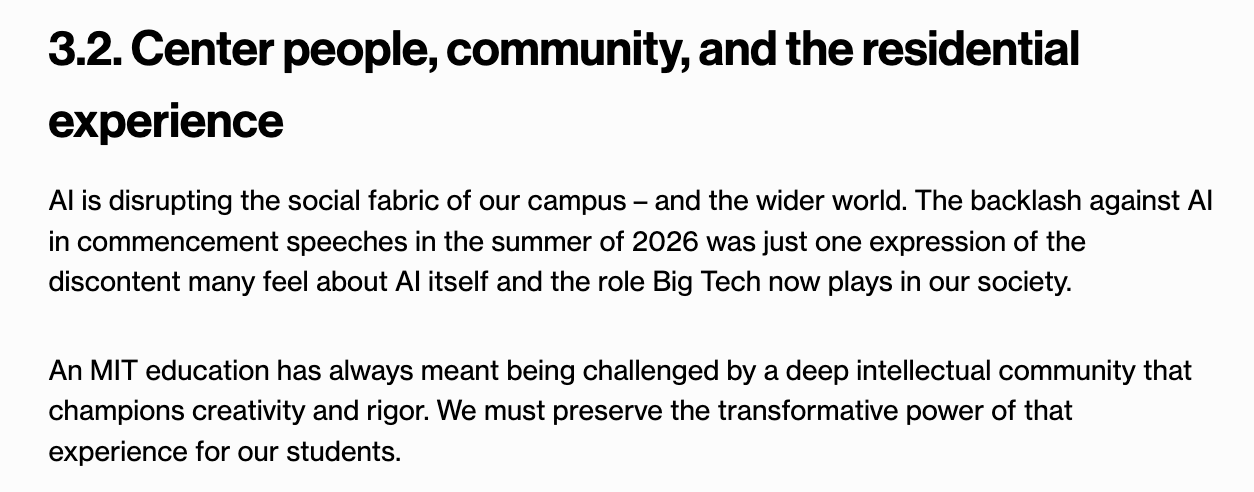
The recommendations provided in this report are broken up into three sections, with an entire section going into the call to “Center people, community, and the residential experience.”
This wasn’t merely naming “centering humans,” either—it was a multi-pronged list of action steps that were people-centered in every way, from defining and uplifting “the value of a residential education” to encouraging instructors to disclose their own AI use to be “transparent with their students about how and why AI is being used.”
For me, this part of the report reinforced that a conversation about our path forward around AI cannot be divorced from a conversation about how we build trust and connection across our learning communities:
[AI] is imposing new pressures on a community still working to restore the foundational habits and attitudes that residential education depends on: showing up, building trust, enthusiastically joining shared efforts, and living with an easy sense of mutual obligation. AI could accelerate this erosion. Or it could be the impetus for a deliberate rebuilding.
Perhaps more than anything else in this report, what was most meaningful to me was this clarion call for interrogating and doubling-down on community: “We also need to engage many more people across campus in conversation about shared norms and why community matters.”
Talking about AI necessitates talking with each other—and the path forward will need to be a collective one.
The strength of that collective, then? It matters a great deal. We need to care about it.
So what does this AI report from MIT mean for me as a K-12 teacher?
Along with what I’ve written about thus far, I’m reminded of three things after reading and reflecting on this report as I step into the new school year in the forthcoming weeks—three things that I think are relevant for all of us in education:
The path forward is not about consensus (and shouldn’t be) — This is a reminder, I think, no matter your particular conviction, that while you should be clear and thoughtful in how you explain your position around AI, I don’t think we are solving anything by trying to convince others to align with our own beliefs. Rather, accepting a lack of consensus and working for a solution amidst that lack of consensus matters across all scales right now: within classrooms, at the school level, and in any potential state and federal policy that may be forthcoming.
Trust, connection and community continue to be nonnegotiable — Are you building trust in your classroom and context? Are you designing for connection amongst students and adults? Are you working towards a community of learning and, most importantly, holding yourself accountable to that community? These are questions that this report underscores that are relevant to every education space right now—and no matter what particular choice or policy you choose, having a good answer to these questions feels worthwhile.
We need conversations more than policies—including in classrooms — To double-down on my takeaway from my Humans First conference reflection a couple weeks back, the quality and humanity of this report did not arrive out of someone’s top-down policy. Rather, it was the work of a committee of various perspectives, and undoubtedly conversation after conversation around this topic of AI and the plethora of tendrils sprawling from it into pretty much every other aspect of education. So yes, rather than arguing about the “perfect policy,” we need more conversations, including more conversations in our classrooms.
So while I still do not work at MIT, I still do very much value what this report is—and even more so, the example this report sets for the rest of us in how its findings are conveyed.
This might just be what a better direction looks like. (I think?)

Beyond the MIT report this post is built around, there were definitely some other things this past week that I was thankful I stumbled across—including two podcast episodes!—and, if you enjoyed this piece, I’d definitely recommend all five of the following options:
How tech took over from Alexander Russo's The Grade — Especially after to getting to meet and talk with Audrey Watters at the Humans First conference in Atlanta, I was absolutely excited to see this conversation show up in my email—very much a valuable listen!
How Nicholas Ferroni is Rewiring His Classroom for Human Connection from Edutopia’s School of Practice — Another conversation that I genuinely enjoyed, this time because of how authentic it was: an actual teacher making an actual choice around technology in an actual classroom. In a world of pendulum swings, this felt like a better type of way.
The Scandinavian Solution to A.I. in Schools by Jessica Grose — Yet another example of the way the winds are starting to blow against technology…this time in the opinion section of The New York Times! Though the original title of the piece softened a bit (no clue why) this quote from Dana Bash to our Secretary of Education is still featured: “Are you concerned that students are effectively becoming sort of guinea pigs for chatbots?”
Experience and Epiphany by John Warner — Just take a look at this quote from yet another important piece from John: “Gradually, I realized that learning to write is essentially rooted in “mistakes,” and that my role was an instructor was to give students access to experiences and feedback that would allow them to make the most productive and meaningful mistakes possible.”
Lingering…? Wondering…? by Garreth Heidt — I know there are already so many Substack newsletters, but the arrival of this new one? As someone who deeply values Garreth’s perspective and the body of work as a teacher that it evolved from, this was an auto-subscribe. Very excited to see what’s ahead!
Note: credit for cover image for this post goes Pexels.com and Tima Miroshnichenko
How else do we end up at Atlanta without the phenomenon you covered in this at MIT...do you know the work of Gary Stager? He is an interesting voice in this space. Very good work here in your post Marcus, TY.
https://thescreentimeconsultant.com/work-with-emily/school-certification?utm_source=substack&utm_medium=email
https://www.linkedin.com/safety/go/?url=https%3A%2F%2Flnkd.in%2FeAAmxtaB&urlhash=iYiF&mt=bev2bmmFfs2-b1gZtoEBxSW8zsSbVPE4KweQcu7y25zv5I9ZR6UcdGUkVkcHAc5TmipgmwD77RrdRnuWpgt-opbT_j7opLTKibwIFF_TK0Y7UbOcbnnkUQ&isSdui=true&lipi=urn%3Ali%3Apage%3Ad_flagship3_detail_base%3Bu4BYccoiS9CClp4b4JW7lw%3D%3D
Hey Marcus— I really appreciate the framing here. Check out my 2022 blog on this: it explores "allosensus" (Nikulin)—a third way beyond consensus/dissent that preserves disagreement while validating the other person, keeping dialogue open. Ties to Littleton & Mercer's exploratory talk—seeking consensus (not forcing it) can deepen dialogue instead of shutting it down prematurely. https://rodjnaquin.substack.com/p/whats-better-than-either-consensus