


October is the month on the calendar that really can mess you as a teacher.
In some ways, the uneasiness of those initial weeks has thawed and there is a burgeoning authenticity in the classroom. You are getting to know students and they are getting to know you. Many routines have a comforting settledness to them. The inside jokes are forming. Students have buckled in alongside you for the longer journey that is the school year—and that can feel good.
At the same time, October can also be when things get much more challenging.
Students who were committed to having a strong start might now be letting go of the rope a bit. The difficulty of work is increasing across all their classes at once, not to mention that formatives are turning into summatives and that online gradebook that is always one click away from students? Spoiler: the grades might not look as good as they did in the opening weeks of the year. Add in absences and add in illnesses and add in miscellanea—October has so much miscellanea, right?—and as good as October can be in some ways, in many other ways it is an absolute wall.
My point: in pretty much every classroom, you can feel October.
Despite the inevitable the October of it all, though, I do think there are some small things you can do as a teacher to make sure the latter isn’t fully outpaced by the former. For today’s random weekend post, I wanted to share four “moves” I try to make as a teacher within these more-difficult stretches—especially when I find myself in a place of carrying the negative stuff of this work more than I’d like to.
And please, feel free to respond in the comments: what is your own move as a teacher in these stretches? How do you respond intentionally when things get more difficult? How do you survive October?
Move ⓵: Wait a Day To Respond
You’re teaching a class and fully in the moment, but for some reason you have to dart back to your desk and you notice an alert.
That email message you were not looking forward to.
One of the overwhelming parts of teaching is the constant straddling of being present with students all day and still navigating the various other responsibilities of the job—many of which show up in our world through digital can-show-up-out-of-nowhere messages that are just a click away.
The problem, however, is that when those digital messages carry a weight to them—observation data you might not be looking forward to; a difficult email exchange; a reminder about something that is already late—that weight can slip into the classroom the moment you click on it.
It’s October, so of course you click on it.
(You couldn’t help yourself. It was right there!)
Now you’re really straddling. You want to be present and engaged and positive with the students in the room but your mind is already unpacking whatever was in that email and strategizing the response. This is stressful in the moment and also takes a toll over time, I think, if this becomes your normal.
Here is what I’d suggest instead if you get a non-urgent message during the day that you anticipate will be negative: ⓵ don’t open it while you’re in the middle of teaching and ⓶ pick a time the next day to respond more thoughtfully.
The value of waiting to open it is rather straightforward: it allows you to stay present within the classroom with students that is a win for them just as much as it is a win for you.
The intentional delay? I believe that’s also important in that your immediate response might not be your best response—which can then snowball into more and more email back-and-forth’s that might feel good in that moment but inevitably are going to take over your thinking pretty quickly.
Still open it. Still respond, if needed.
But give yourself time and protect your presence. (It is worth protecting.)
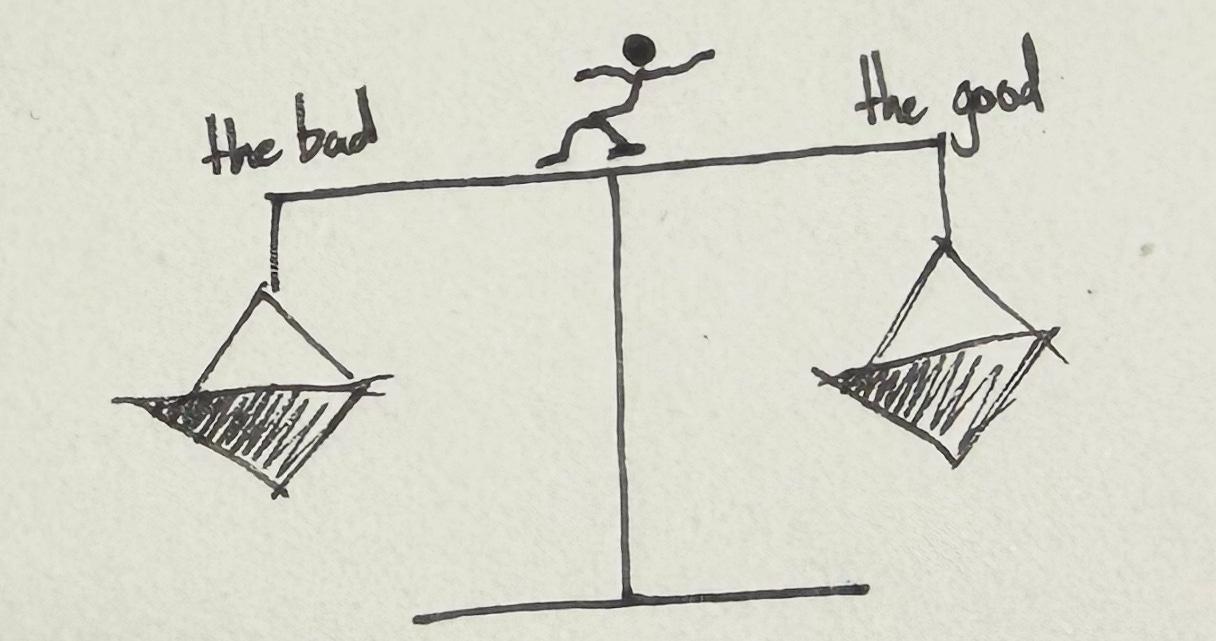
Move ⓶: Counterbalance with Good
Let’s just continue the example from the previous section and imagine that you are now in a situation where you might be dealing with a less-than-positive interaction in your work. Whether in the classroom with a student or finally responding to that email from earlier, teaching is human work and human work can be challenging! Not all interactions are easy, and sometimes this means interactions that can add stress or frustration that linger long after the interaction ends.
What I’ve been trying to intentionally do in response this year has been to hold onto a picture of a “balancing scales” in my mind (see above)—to think about when I am engaging with something that is adding stress or frustration on one side of the scale and then to consider how I can invest in something more positive on the other side to get it back to a more-balanced place.
Difficult conversation with student in the hallway after a tough stretch of classes?
Next step: look through your list of students and find 3-4 students to send a positive note to a parent or coach about how well they are doing.
Email exchange about an idea or program you suggested that ended up not getting approved?
Next step: go find a colleague you appreciate and find a way to celebrate their impact—at minimum, just tell them why their impact has been meaningful to you.
Notice that students aren’t necessarily making the best choices about prioritizing their school work?
Next step: instead of naming the negatives, blast out a message to them and their families uplifting the many good choices students are making:

Sometimes we do not have agency over the stressful or frustrating aspects of our work, but I do believe we have agency over how we continue to lean into what is good—including how we name and invest in the good we are seeing around us. Counterbalancing with good isn’t just a way to get through October, either, as these investments in good can be seeds that result in long-term rapport and trust.
Plus, it just feels good. That’s not nothing—particularly in October.
Move ⓷: Remove Something From Your Plate
Without question my favorite “edu-listen” this week was a conversation between Dr. Andrew Miller and Shane Learning on Education Leaders podcast. The entire discussion is worth listening to, but I felt very seen near the end when Andrew shared about his “Maybe Don’t” philosophy as a school leader:
“Like, you could have the best idea ever, and it’s the right idea. It needs to happen. But is it the right time? Is it the right context? What else is going on? Like how are people doing?” –Andrew Miller
From the teacher lens, also worth asking: how are you doing?
My guess is that a lot of teachers and educators reading this have a lot of good things on their plate—that’s what we do as we gain experience, right? We start to accumulate what is good and meaningful in our own practices, for ourselves and for our students. In our classroom and often beyond it.
I recognize that all this accumulated good can become its own obstacle, though, when the label of “good and meaningful” prevents us from honestly assessing our capacity and removing something from our plates when necessary.
As Andrew named in the conversation, just because something is a good idea doesn’t mean you should do it right now.
In my own classroom, very early on this year I recognized just how much was going to be on my plate between class size and my largest ever group of AP Literature students—meaning a major increase in the number of essays I’d be reading and leaving feedback on. I also was really excited to try out a couple new systems, including one based on the work of Angela Stockman around student documentation that I’m already over-the-moon about!
Yet in adding these new things and assessing my context, I realized that I needed to also remove some systems, which is why I ended up eliminating a mindmapping reflection ritual that I had been doing for over a half-decade in the classroom. (Note: yes, that is a Wordpress blog link!—this ritual was around well before The Broken Copier was a thing!)
It wasn’t that I lost faith in this ritual’s value—just recently, in fact, I received an email from a college student naming this ritual as the most important thing they took from our classroom and a practice they continued leaning on even after graduating!—but rather that I realized I was at a “system overload” in our classroom.
I believe a core part of teaching for me at this point in my career is the design, implementation and maintenance of the systems in our classroom—and at some point quantity can have diminishing returns on quality.
So it had to go.
I do miss it!—but I do not miss the stress of having yet another system to keep track of, especially early in the year when as a teacher I’m doing more legwork to get the other systems up and running. Unquestionably, something I appreciate at this point in my career is my ability to recognize when my plate is a bit too full and, when necessary, make the right choice in taking something off my own plate.
(This is also why it has been a good stretch since a new Broken Copier episode has gone out. Between scheduling and recording and editing, those episodes take a lot—and once the school year is underway, that “a lot” becomes ten times more difficult. So this year I decided to make this difficult “cut” for the time being, despite there being many conversations I’d love to have! At some point we’ll get back to recording, but for now I have to continue taking my own advice on this one.)
Move ⓸: Return to Your Values
Whereas the first three “moves” in this post are quite tangible, this final one is more reflective: taking a beat to reflect on your core values and consider where your choices and actions are in alignment with your beliefs—and where you might be a bit out of alignment.
Thankfully, in my classroom these core values are pretty much everywhere I look, from the syllabus to student desks to the classroom walls, offering a constant reminder to not let go of what matters amidst what is difficult.
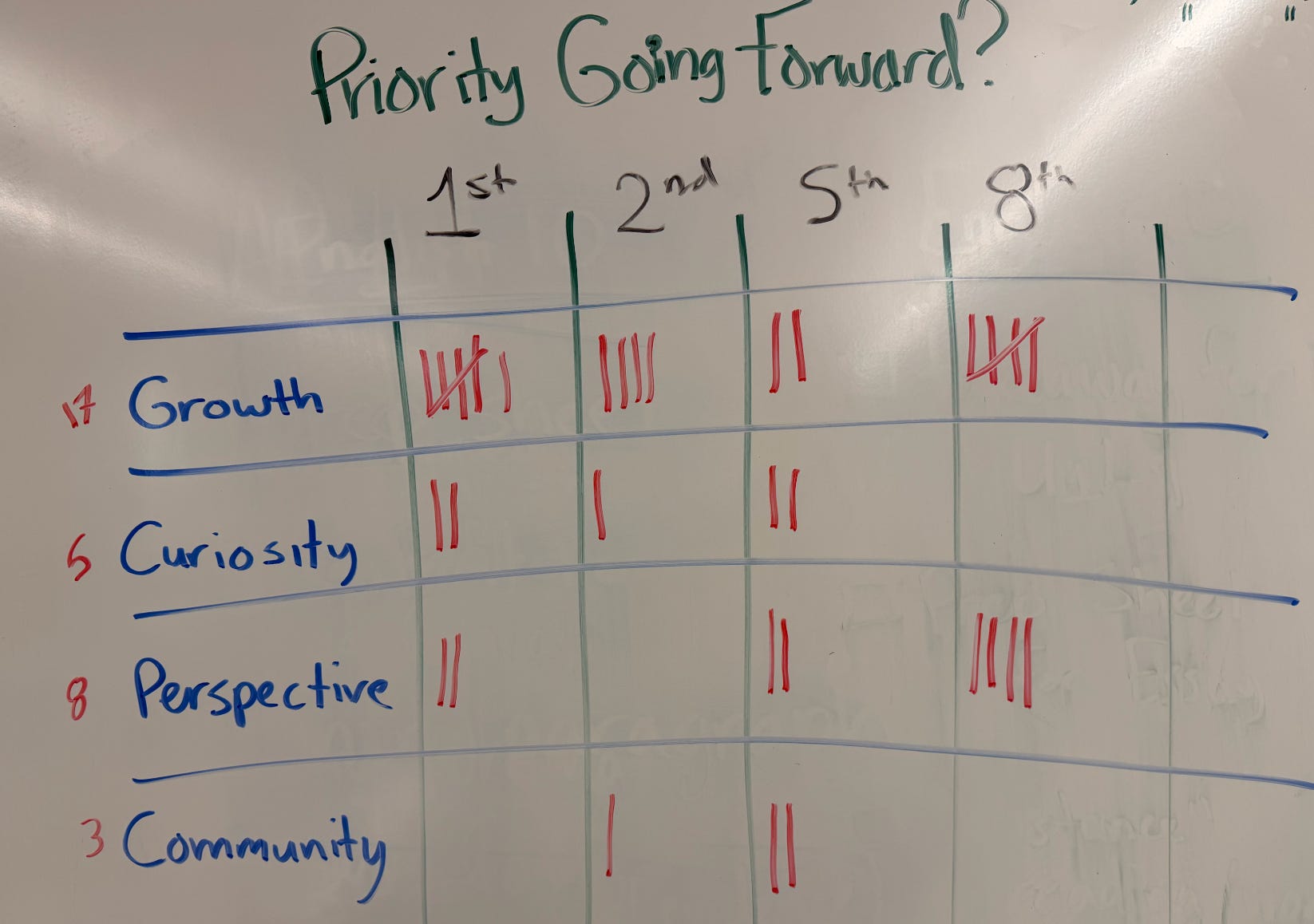
I think that is why I tossed this question back to my students this week: “Which of our four core beliefs needs to be a priority going forward?”
Each small group reflected on their collective answer and then recorded it on an index card, and at the end of all my classes I had 33 “group votes” tallied on the whiteboard (pictured above).
There are many types of burnout as a teacher, but I think the most pernicious is when you start losing grasp of what actually matters to you in this work—and for me the best way to hold myself accountable to my own values is to make them as visible as possible and, when I can, to invite my students to hold me accountable to those values.
Which they did.
Which was perhaps the best part of my week.
The Thing About “Moves”
I realize that the initial premise of this post was to prioritize what is tangible: specific “moves” that you can make as a teacher when things are difficult—to avoid those challenges escalating further and, potentially, keeping you from seeing and holding onto what’s good in this work.
Nevertheless, the thing about “moves” is that, while they might make for a very clickable post, none of them are guaranteed to work.
Slowing down to respond to a difficult email does not eliminate the difficult email, not to mention that it isn’t necessarily the best habit to be consistently delaying email responses. Counterbalancing with good is something I’ve long been a fan of, but this advice can quickly fall into the “toxic positivity” trap when there are deeper, ongoing challenges weighing you down. And sometimes the things on our plate that we should cut are not things we are able to cut.
“Moves” work when they work, but not always.
Especially in October.
This is why it felt important to add the fourth “move” of reflecting on my values, a less-tangible but more-resilient lens that I have come to lean on more than anything else as a Year 15 teacher.
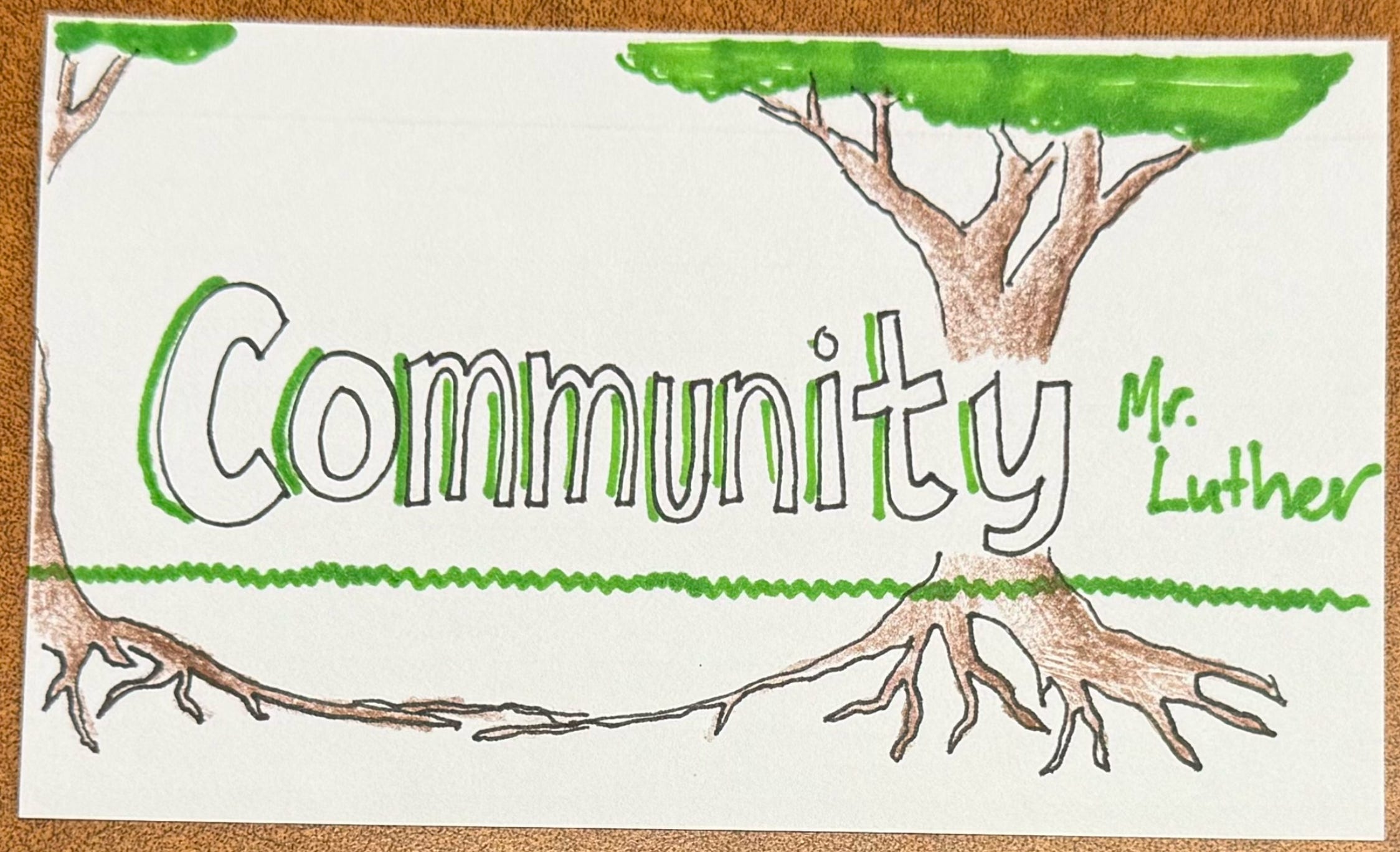
This is yet another reason I’ve loved my new weekly habit of a sketchpad mindmap this year to reflect on my own values against what is happening on the classroom on a daily basis. It is why I have every student’s top value next to their name on my attendance rosters—literally in my hands throughout the day!—and it is why I’ve loved Tom Rademacher’s strategy via Jennifer Gonzalez’s Cult of Pedagogy in having every student’s top value decorated on the classroom wall. (I’m not going to post because all the student names are visible, but let me tell you: it is incredible to see! I’ve got my own example pictured below, so just imagine nearly 200 more of them.)
The most valuable thing, though, about holding tight to a values-centered lens?
The way it can get reflected back towards you—including from students.
We had just gone through our first round of students capturing their learning by taking pictures of their spiral notebooks, and in reading through these reflections I found that one student had taken a picture of the classmate roster they had taped inside the spiral cover, along with this explanation:
“I like that we can all share and learn little facts about each other without telling one another. This is important to me because we talk to our classmates a lot in this class and knowing something slight about everyone brings comfort and a community feeling to me at least.”
Seeing that student choose that to prioritize for their reflection? That for them, the “community feeling” was the most valuable thing they took away from the opening weeks of our school year?
That filled my cup more than any “move” ever could.
Bring it on, October. (Now I’m off to knock on some wood!)

Last week I didn’t have the time to include different listenings and readings, so I wanted to make sure to include a bit longer list today! After all, yet another “move” I’ve found meaningful in difficult stretches has been to lean on other teachers and educators for ideas but also inspiration—and everything listed here has offered that for me over the past weeks in some sort of way:
The Myth of the Neutral Classroom by Jared Fox – I feel like this piece lines up perfectly with what I’ve included here around values, as Jared is clear-eyed about the purpose behind our work: “Because that is what we as educators do - we work with those who will inherit the world and stories that have yet to be written.”
What Are We Really Assessing? by Angela Stockman – This brief piece offers a really thoughtful example to push your thinking and reflection around grading—including the closing reminder that regardless of your perspective on grades, inevitably they have consequence: “It’s a story that each child will begin to tell about themselves.”
Don’t Fall for a Simple Story by Dylan Kane – I haven’t been shy about sharing my frustrations about the conversation around reading, in part a result of the first season of the Sold a Story podcast. So when I heard that Season 2 was coming out? Even more cynicism—but I’m grateful that there are voice’s like Dylan’s that offer a more pragmatic, balanced take on it.
9 Simple (But Transformative) Classroom Management Shifts from Edutopia’s School of Practice – If there was ever a podcast episode to listen to in October, this conversation with Tyler Rablin would be it. (Seriously: I’m taking specific strategies from this into my classroom next week!)
What’s Left for Public Education? by Jennifer Berkshire – As someone admittedly quite disillusioned with how progressive education was largely co-opted by the education reform movement over the past two decades—and yes, as someone who entered teaching through Teach For America, I recognize the irony in that!—this piece resonated with me a lot. Values matter at a systemic level, too.
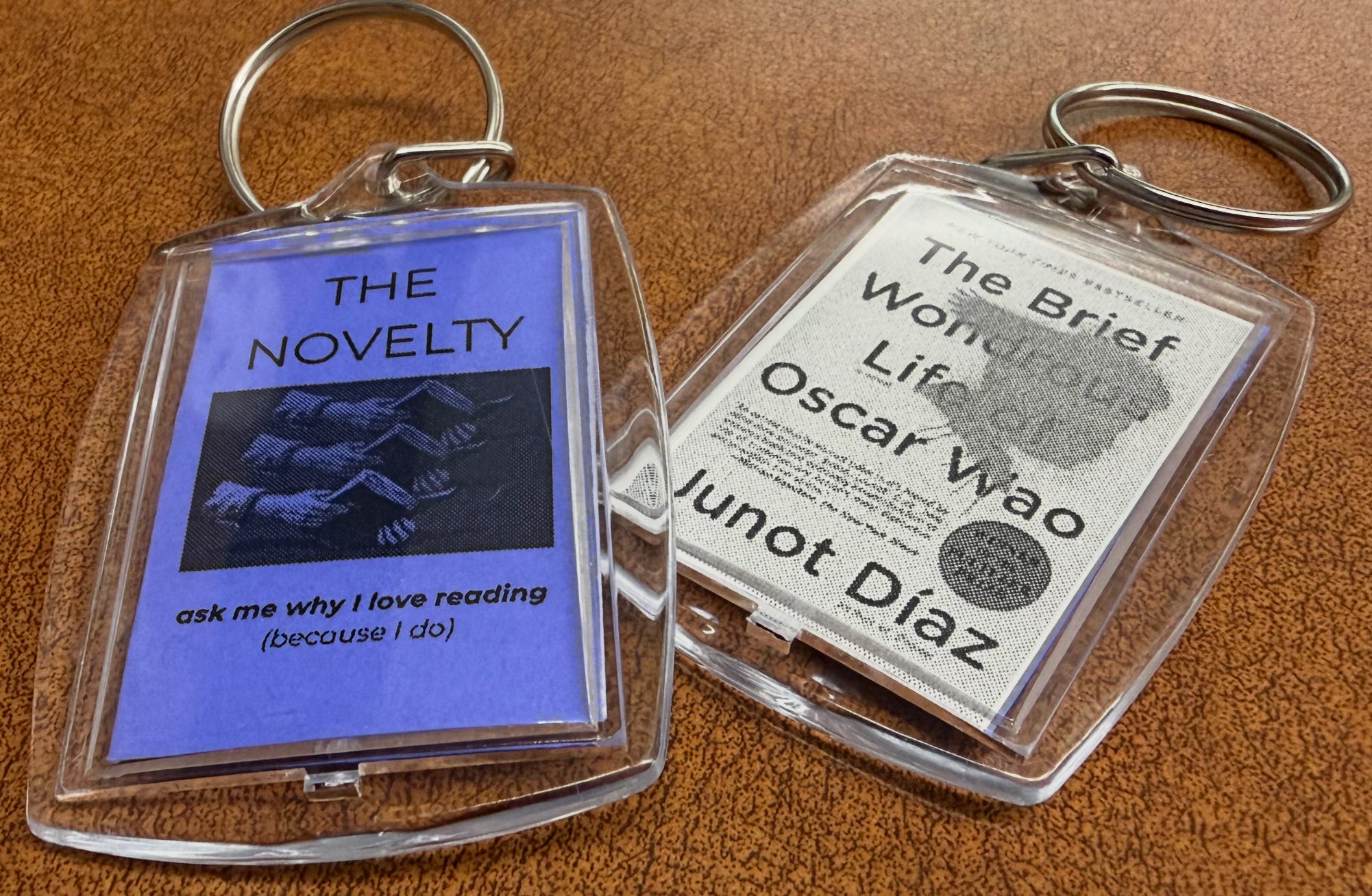
How Book Cover Keychains Boosted Our School’s Culture of Reading by Carsyn Smothers – I have to give a shout-out here to an article that immediately came to life in my own classroom with a book club several students wanted to start with the goal of promoting the value of reading. Not too shabby, right?
I apologize, too, for getting a bit off-schedule with these posts. It’s October, after all! But when I can, I will keep trying to share out what is working and also what is on my mind—and know that those many thoughtful comments and random kind emails continue to fill my cup every single time. I’m very, very grateful for all you who continue to read and support The Broken Copier—especially in October! –Marcus
I always plan a couple of “easy” teaching days in October as well. I plan something students can easily complete on their own, giving me time to meet with those kids whose grades are slipping.
My first thought reading this was, man, Marcus must have gotten a really difficult email! But October is definitely when reality hits - for me it’s writing college recommendations and juggling my weekend extracurricular commitments in top of every of else. And I don’t know if your kids are old enough to start with the insane sports scheduling but that also takes a toll. For me it’s been cutting back on my writing which I am loathe to do but something had to give. My advice on the email? Respond with a short note and turn it into a phone call / in person conversation. If I am writing an email longer than two lines that is not just conveying information, it should be a live interaction. Good luck!