
5 Quick, Impactful Moves To Start The Year
different "moves" that have helped me get off to a strong start in recent years


Well, we’re here: the eve of a new school year—for some, I know, students are already arriving!—and all that comes with it.
While last week I shared three things that I’d encourage every teacher to consider doing for themselves going into a new school year, today I want to shift focus just a bit towards five quick moves that I’ve found helpful in the opening weeks of recent years.
Setting aside more-comprehensive strategies and resources, sometimes the little things are what end up being felt most meaningfully in those opening weeks—weeks often full of schedule changes, supply abundances followed by supply shortages, just-holding-on hoarse voices, and that oh-so-satisfying collapse into that first weekend of a school year.
A weekend that always evaporates way too fast.
This is why, I think, the quick moves as a teacher early on can be the most impactful—in terms of the payoff in the short and long term.
The other thing I want to do with this list of “moves,” however, is to offer a potential challenge with making each of these moves. In my experience, very few things that are actually effective in this work are without any downsides, and so I did my best here to anticipate what a minor negative could be for each. It’s better, I think, to thoughtfully attend to downsides rather than pretend they don’t exist.
Without further ado—after all, the goal is to be quick with these!—let’s dive in.
Note for readers: if you have a quick, opening-weeks strategy that works in your classroom, feel free to share in the comments, too! So many thoughtful shares of late in the comments—let keep it going!
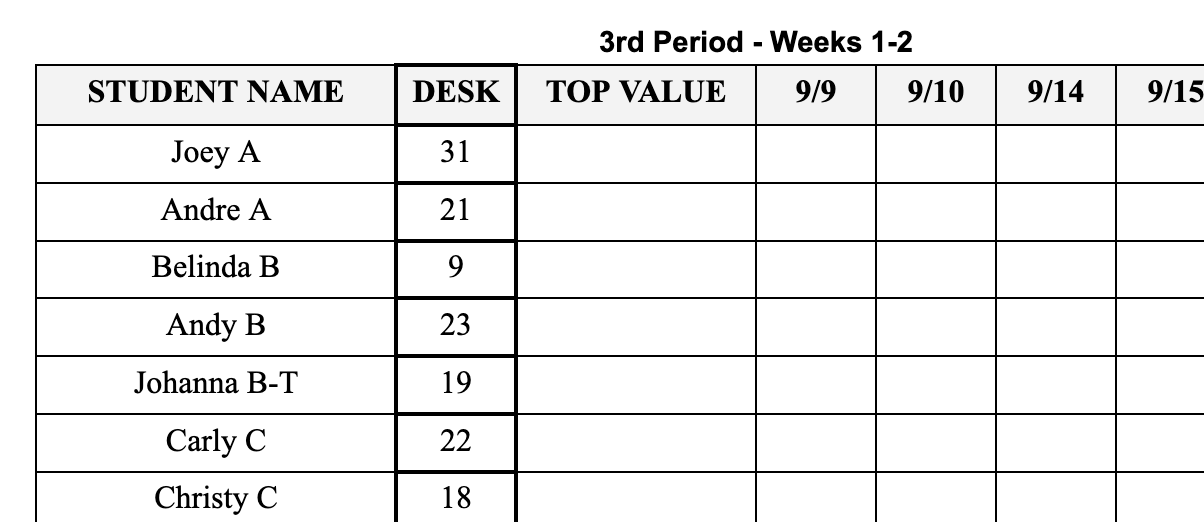
⓵ Clipboard with Student Desk Numbers and Names
As I’ve shared frequently, on the first day of school between 150-180 students will walk into my classroom.
I am a big believer in getting to know student names as quickly as possible, and my go-to move is to use my handy-dandy clipboard to expedite that process. I’ve shared before that I am a fan of assigned seats for the structure they offer, but they also make getting to know the names of students much easier—particularly when I build in a lot of early activities where I call on each student for a short answer.
The other thing I love about this: so often I learn things about students over the opening weeks that are important to jot down right away in the moment.
Having a tangible place to capture all of that immediately? A must for me.
Potential challenge with this move? At least at the secondary level, there tends to be some ongoing movement between class periods on the rosters over the initial weeks of the school year, so yes—you have to make some handwritten edits to this! I’d still argue, though, that editing a roster on a clipboard is preferable to literally being empty-handed when a student arrives unexpected that first week!
⓶ “Buffer Activities” for Unplanned Extra Time
Something quite reliable about the initial weeks of a school year? That the schedule will be, well, quite unreliable at least a handful of times.
What I don’t ever want, however, is an extended amount of time where students are just sitting around in the classroom with nothing to do in those opening weeks of the year, as I’m a big believer in the precedent the initial weeks set as far as what the classroom experience feels like for students. Consequently, I want to make sure we are using all of our time purposefully in order to set that norm.
This is why I make sure to have a couple prepackaged activities that I can pivot to if I ended up with some unexpected additional time. I try to keep these low-tech, too, such as an index card reflection or a whiteboard competition, as I think most veteran teachers know that relying too much on technology early on in a recipe for disappointment. (If not chaos!)
Potential challenge with this move? I know many are resistant to icebreaker activities that fill time without necessarily conveying purpose, and I think it matters that whatever you do, you are able to explain why it is meaningful to the students in the room.
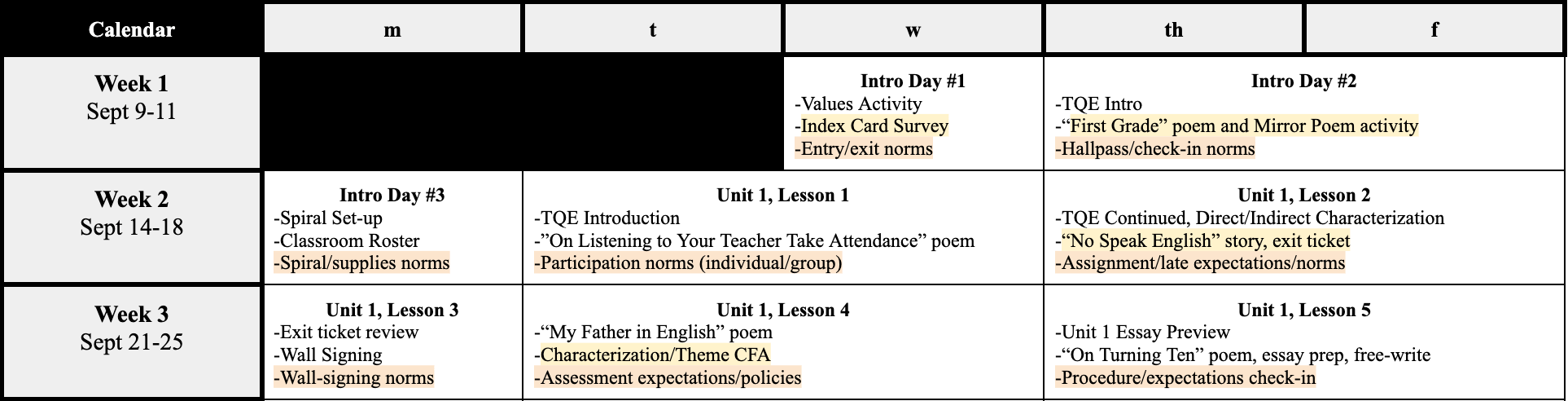
⓷ Spread Out Introducing Procedures and Expectations
A mistake I made earlier in my teaching career was trying to go through far too many procedures and expectations the opening lessons of the school year.
Spending the entire first lesson reading through the syllabus and talking at students?
Not what I’d recommend.
Instead, when mapping out our instructional path for the start of the school year, I also create a plan for when I’ll introduce specific expectations and model procedures for our classroom. While this requires a bit of patience, it also allows us (a) to dive right into learning and community-building activities and (b) to model and fully explain each of the procedures and expectations, including the thinking behind them. Rather than trying to speed through them too quickly, this allows classroom procedures and expectations space breathe—and, in my experience, to help them settle into a more reliable foundation for the school year.
Potential challenge with this move? The patience part. Sometimes it feels like you have to cover everything right away as a teacher as far as expectations and procedures, and that’s 100% fair. Given all the schedule changes of the opening weeks, etc., it could also make sense to hold off on learning activities students will all need—and I’m open to feedback in the comments on this, too, if others have a different vantage point!
⓸ Make Extra “Starter Packs” for New Arrivals
Confession: this one is directly inspired by Adrian Neibauer and the beautiful intentionality in how he welcomes new students to his classroom.
As noted above, I like to dive into what we’re doing right away—often with these initial lessons—but that also means that if a student shows up a class period or two late, we’ve already gotten started with our work!
This is why I keep track of who is absent and set aside extra materials for each missing students, along with a few extras—as you never know who the magical schedule gods will drop on your classroom doorstep during those opening weeks! In particular, I think this is important for ongoing systems in our classroom, such as spiral notebook set-ups, which can be a bit more tedious to get caught up with if you missed out on when they were formally introduced.
By creating these “starter packs,” then, I’m able to show to a student who arrives late to our course that I was still thinking of them—and that I’m invested in helping them get into the swing of things as quickly as possible!
Potential challenge with this move? While the intentions behind this are good, I do recognize that for a student showing up late it might feel like a burden to be handed all that they had missed, so I think how you communicate this matters a great deal—and you should definitely note how they respond, too, in case you need to change course with this.
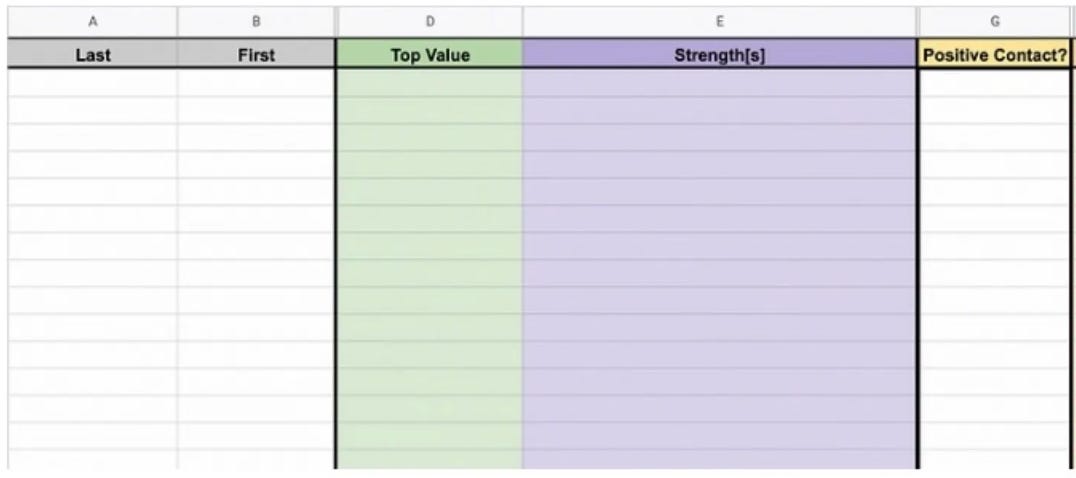
⓹ Have a Go-To Place to Keep Track of Student Info
I shared this one a few years back, but I wanted to include it once again here: a pre-designed Google Sheet (template here) where I not only have my own roster for each class period but place to quickly start jotting down everything I learn in those opening weeks.
By creating a tab for each class period on my teaching schedule, this allows me to have a one-stop-shop document to keep referring back to throughout the year—and to keep adding to and adjusting as the year moves forward. From tracking positive contacts to adding random notes (ex: needs to sit near front of room), I’ve found it very helpful to keep all of this in one digital location.
The other benefit? It is then very easy to make other lists and sheets with the rosters you have here, which can be helpful for tracking student learning and other activities over the school year!
Potential challenge with this move? I end up making quite a few changes to it as schedules shift over those initial weeks, but I’d much rather have this information ready and then edit than wait until things have settled. You learn so much in those opening weeks, and having a place to keep track is worth the edits you’ll inevitably make, in my opinion.

I’m going to make a bit of a pivot this week with our “left in the copier” section, as I wanted to link to a few recent things that I had the privilege of sharing in different places than here!
A Classroom Ritual for Peer Affirmations — I had the privilege of sharing our “signing the wall” ritual that has lived in our classroom for more than a decade with Jennifer Gonzalez and Cult of Pedagogy, with both a post and conversation about what this practice looks like and, most importantly, why it is without question one of the most meaningful spaces in our classroom.
Podcast: How to Jumpstart Belonging in Your Classroom From Day One — last month I was interviewed about our opening lesson activity for Edutopia’s School of Practice podcast, and it was a great chance to share not only the “what” behind the index card survey I lead off the year with but also the why behind each aspect of it. (For other beginning-of-year resources and conversations, I’d also recommend checking out the Teacher2Teacher discussion forum!)
Finally, I just got back from the Humans First: Adolescent Education in the Age of AI Conference, and my initial report is this: it was a gift of an experience. To be able to meet with a thoughtful group of educators over multiple days to discuss the realities of AI and its collision in the classroom? A genuine, humbling joy, especially getting to learn from folks who I have for a long time read from afar.
One other very cool thing? While at that conference, I happened to look up when walking down a school hallway, and what did I see? A very familiar wall:
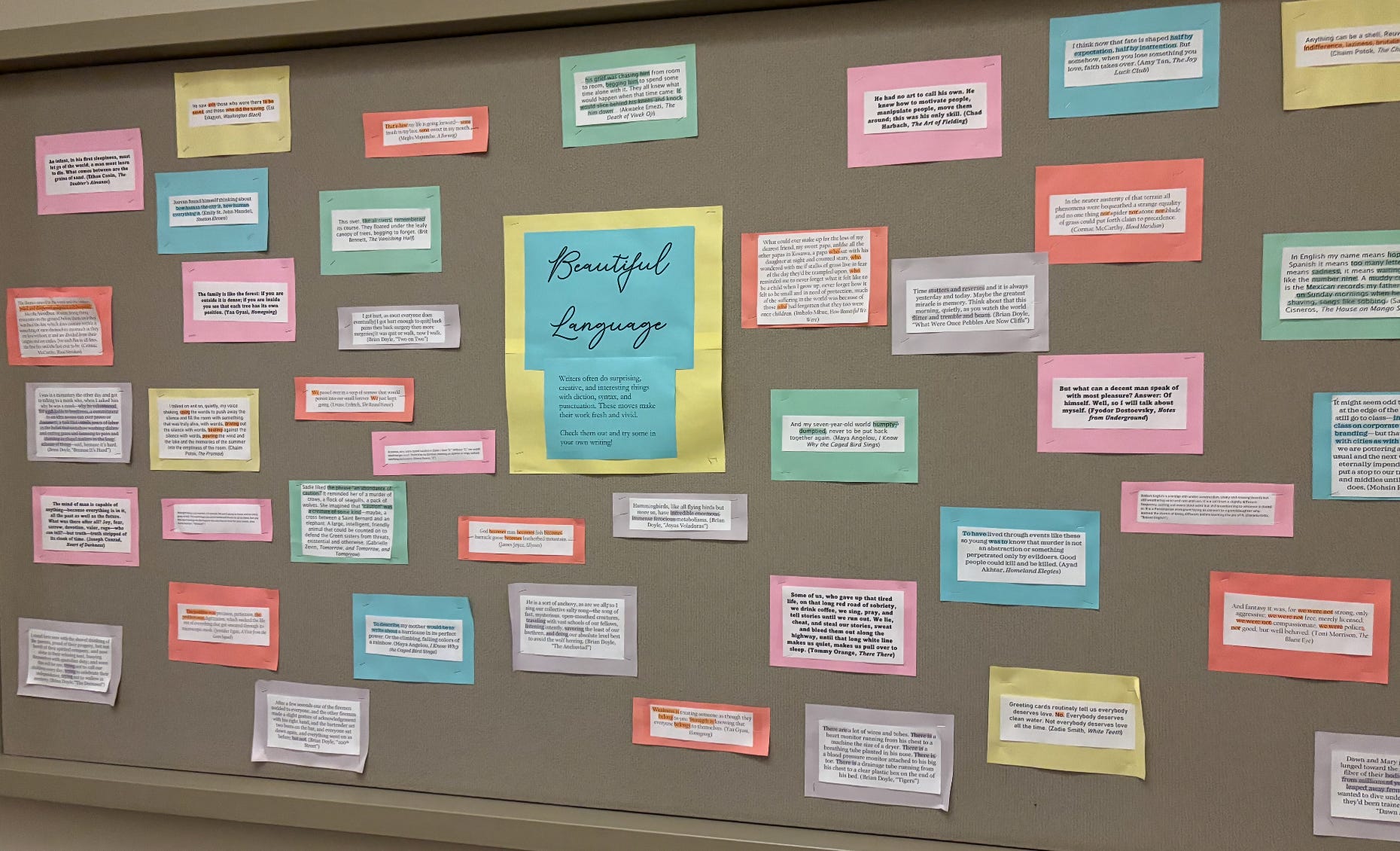
Talk about something that honestly fires you up! To randomly happen upon this three time zones away was the ultimate affirmation, and please don’t hesitate to keep letting me know if something from The Broken Copier ends up showing up in your classroom—including if you adapt it into your own version!
Sometimes we need a reminder that the connections across our work matter, and for me this undoubtedly was that reminder, which is why I’m very thankful to have looked up at the right time.
And most importantly: for those already back in your classrooms, I hope you have a phenomenal start to your school year! Take care of yourselves, soak up all the positives that you can, and know how much this work can matter.
Marcus,
Rod just shared your essay, and it reminded me how much I miss your voice on Twitter. I so glad I found you again!
Right now, the feed is drowning in the same science of reading scripts, knowledge organizers, and one-size-fits-all takes. It's exhausting. And it's missing the kind of thoughtful, grounded conversations you always brought to the table.
I know you're high school and I was elementary, but I always loved reading your work especially your lesson ideas. I used to wish my kids could be in your class. That's not something I say lightly.
If you ever feel like sharing your Substack or just one lesson idea on Twitter again, I know I wouldn't be the only one grateful to see it.
Either way, thank you for writing. Your work matters.
Love these! In the past, I've done an email for absent students. I draft it after the class, but add recipients while taking attendance. I like the packet idea for the other physical things. Thanks for writing this!