
Three Things I Would Encourage Every Teacher To Do Going Into This School Year
No matter what you teach or how long you've taught


Last week I came across an article that I haven’t been able to stop thinking about.
The article was called “What Actually Makes a Classroom Work Has Nothing to Do With What You Teach” by Jennifer at The Real Classroom, and all ten pieces of advice it offered for teachers were undeniably valuable. To share a few of them here:
“Be honest with your students” (*nods*)
“Do not let yourself be antagonized by a teenager” (*nods*)
“Let your students see why you love what you teach” (*nods intensely*)
The piece overall was generous with its wisdom for teachers, and in my mind offered a great reflection for any teacher going into a new school year: which of these do I do well—and which have I lost a bit of a handle on?
But I don’t think that’s why it stuck in my head as long as it has.
Rather, I believe what resonated most with me is how different this piece felt compared with so much else that’s out there.
Not weighed down by excessive footnotes and citations; not interested in “the current discourse” of trending pedagogical debates; and certainly not attached to any initiative or program.
Just thoughtful, helpful pieces of advice from an experienced classroom teacher.
“If someone new to teaching asked me for advice,” Jennifer wrote, “these are the things I’d want them to know.”
This week I want to borrow this type of simple, authentic pragmatism for a similar aim: what are some things I believe would be helpful for any classroom teacher going into this upcoming school year?
I came up with three.
⓵ Make “Seeing What’s Good” a Ritual
A small practice I began two years ago at the end of each school day: jotting down a “small, good thing” before turning off the lights and closing the door of my classroom.
When I say small, I mean it—you can see in the video above!—as usually these were just a few words that captured something from that day in the classroom that made me smile, inwardly or outwardly; something that made me laugh, quietly or loudly; something that made me sigh with gratitude or pride or, more likely than not, some combination of these two priceless emotions.
As I’ve shared about before, the power of a “seeing what’s good” ritual like this is the way it changes what you look for.
Throughout the school day, I am aware that I will have this ritual ahead of me before I walk out of the classroom, which makes me much more attentive to the potential good around me.
Because I’m looking for the good more, I see the good more. It’s really that simple.
Of course, this is not a ritual that is meant to distract from what is difficult and what is frustrating and especially what is harmful. A good thing that is merely trying to get you to ignore a not-good thing is, in my eyes, just another not-good thing.
However, as classroom teachers we are surrounded with so much, especially in what students bring into the classroom. And even on the worst of days—I assure you, some of those “small goods” came from the very worst of days in the classroom!—I believe there is good to be noticed.
So why not have a ritual that helps you notice that good?
⓶ Find Something New To Get Excited About
When I had the joy of speaking with Angela Stockman earlier this summer, I knew that I would walk away with that conversation with inspiration for my own classroom.
And I was right.
Hearing her inspiring reflections on her own practices with pedagogical documentation, I realized that this was something that I needed to find a way to bring into my own classroom—not just for me as a teacher, but also for my students to more authentically document their own learning.
Here’s the current (still in the works) plan:
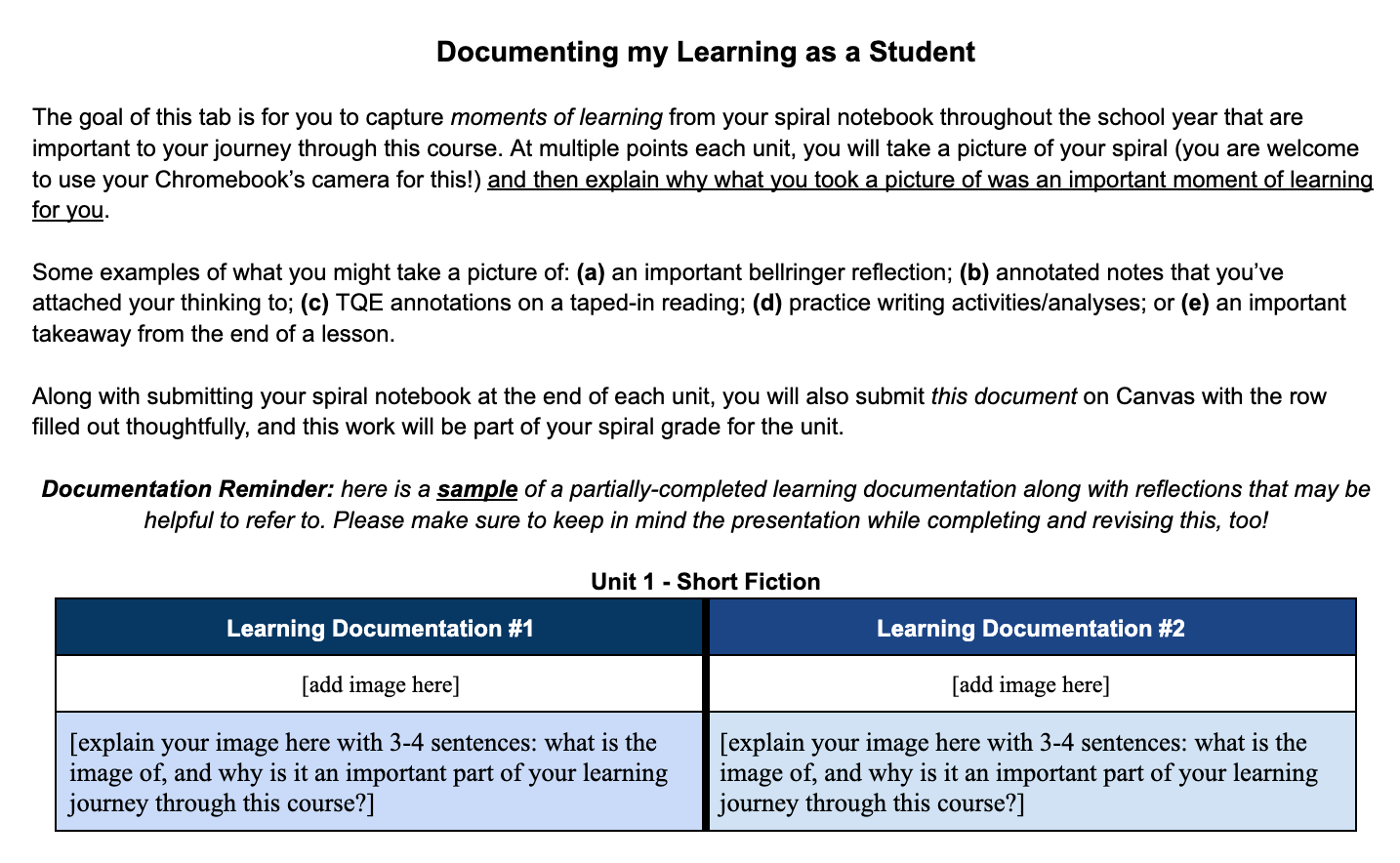
At multiple points each instructional unit this year, we will pause as a class and students will find an example in their interactive spiral notebook that shows a key moment of their learning.
Students will have an ongoing Google Doc (preview here) where they can collect these pictures and attach reflections to each—which will also lead, I hope, to discussions in small groups about what they captured and why.
This will work in tandem with their assessment reflections that they will also continue to track (same document, different tab), and hopefully will be even more authentic, in a way, given that they are more divorced from higher-stakes assessments.
Going into my 15th year of teaching, I recognize that I am at my best and most sustainable self as a teacher when I am leaning into what makes me curious.
Inevitably, there will be other new things outside of my control that will be required of me (welcome to education, right?); undoubtedly, too, it is important to not overlook what is already good in the classroom.
But there’s a reason I try to intentionally carve out space for something new, something better, and something stronger each year: if we are going to cultivate authentic curiosity within our classroom, I think the place to start is with our own practices.
⓷ Invest in 2-3 Adults That You Work With
The first two suggestions are pretty straightforward: focus on what’s good and find something new to spark your curiosity.
Nothing you wouldn’t expect if you’ve been reading The Broken Copier for awhile.
This third thing, though, might feel a bit, well, out of pocket: find 2-3 adults in your building and make a commitment to yourself to invest in your relationship with them.
I don’t just mean learning names and having a few positive interactions.
Instead, I want to really emphasize the word invest: [1] taking the time to understand their work and the values they hold within it; [2] learning how their experience is going at your school and what could make it better; and then [3] committing to do what you can authentically to be a positive part of their story of this school year.
I bring this up because of a mistake I made far too often over my first decade of teaching: failing to recognize that a classroom filled with students can be incredibly lonely when all of your energy is just going to those students.
All of whom will eventually leave your classroom and go to another.
The adults in your building, though? They tend to stick around, at least more reliably than the students will. Not to mention that we’re usually at our worst when we’re going it alone in this work—and the first step in interrupting that isolating cycle is holding ourselves accountable to a simple question:
How can I be a positive part of another educator’s story this year?
(Seriously: write down the question—and even add the names, if you want!)
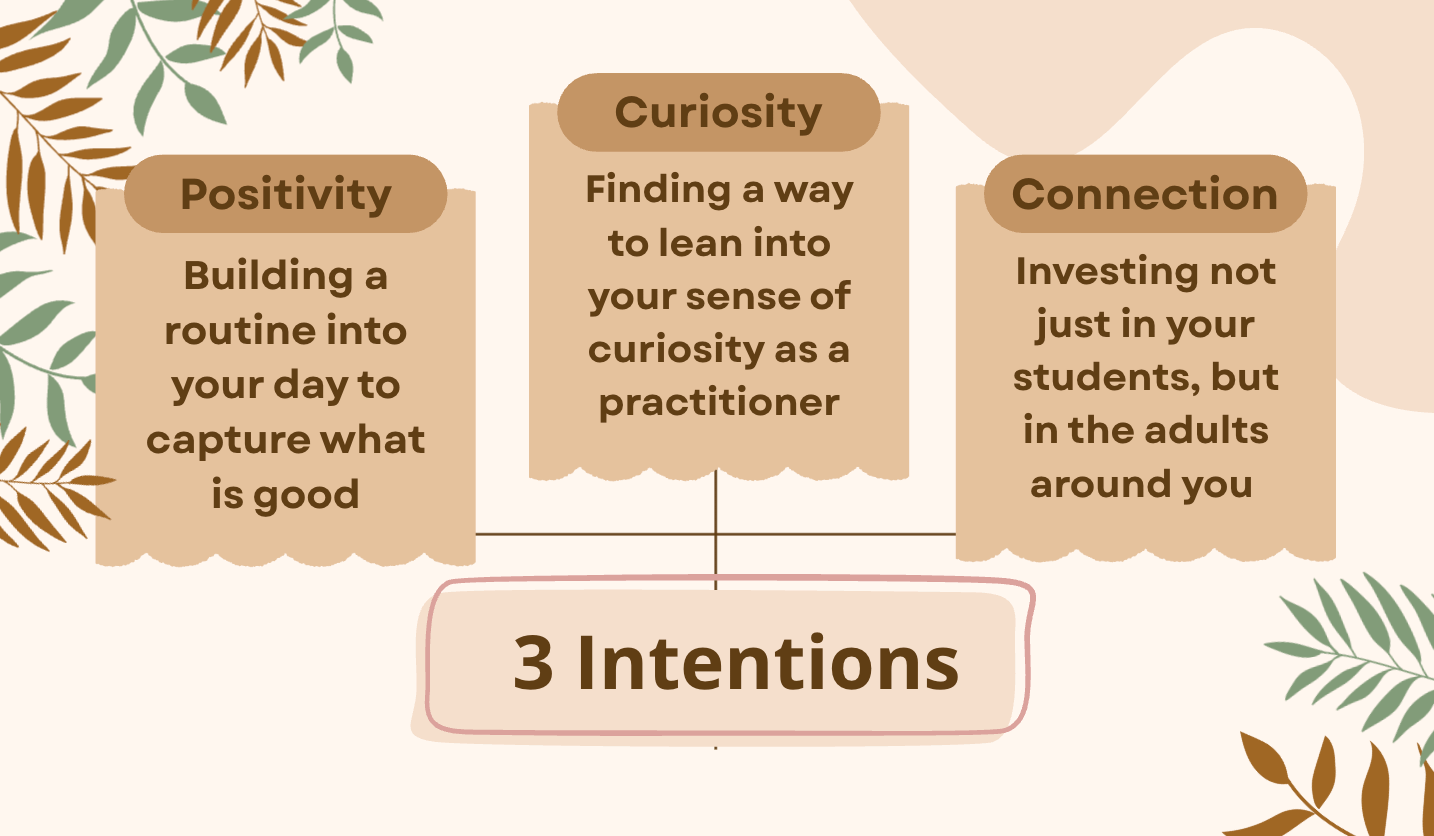
Positivity. Curiosity. Connection.
As impactful as these three things can be for a teacher, I don’t pretend for a second that they will outweigh all of the negatives swirling around the world of teaching right now.
We can press the right buttons, adopt the right mindsets, and still hit an unscalable wall in our work.
Yet setting aside the unavoidable challenges in our current reality and the pedagogical discourse that will always be there when we want to step into the pedagogical discourse, going into each school year I try to remind myself that all of us have a finite amount of years in the classroom and that there are small, good things we can do make sure each of those years is as enjoyable and meaningful as it possibly can be.
Building a routine into your day to capture what is good. Leaning into your sense of curiosity as a practitioner. Investing not just in your students but also in the adults around you.
These are things that have made the last few years of teaching for me some of the most rewarding of my career—and why even with a month left before I return to the classroom myself for Year 15, I already cannot wait.

Building on this theme, there were three other pieces that I came across this week that felt as if they walked in lockstep with the idea of taking the right steps and adopting the right mindsets as we move into a new school year.
You can’t self-care your way out of burnout by Ruth Poulsen – “Self-care” is thrown around a lot in education, almost always with the best of intentions, but as Ruth points out in this important piece, sometimes that’s not enough: “Self-care is great, but it’s not the answer. In my case, the answer was a role in a school where my values aligned.”
When Good Research Gets Implemented Badly by Youki Terada – This Edutopia article is one of my favorites of the summer: listing out six ideas that are grounded in research but, according to Terada, are “increasingly mischaracterized” in their general understanding and implementation. Really refreshing to have someone lay out the actual studies behind the sometimes-faulty ideas being spread! (Note: I’ve been working with Edutopia this summer to share their stories to a wider audience!)
Three Theses On the Literacy Crisis by Trevor Aleo – I actually think this piece fits 100% with today’s theme, as so often the “discourse” around our work stifles the actual joy and curiosity—and what Trevor does here by doing the work to combat that “discourse” around reading and literacy with a thoughtful, nuanced response? It’s inspiring.
One other thing I’m super excited about? This week I’ll be in Atlanta participating in the Humans First: Adolescent Education in the Age of AI Conference, which I hope offers a better path forward to this expanding (and frustrating?) conversation around AI in education. I was recently able to interview three of the teachers behind this conference—Michael Burns, Samantha St Lawrence Collins, and Matt Hicks—to offer a preview of what this conference is aiming for, and I’m excited to share out more after the conference about it was like!
One thing that worked well for me last year was trying to care as much about my 5–9 as my 9–5. We spend so much time planning lessons that it's easy to get home, eat dinner and collapse in front of Netflix. Even something simple like a walk after work, a board game night or setting aside time to read made a real difference. We plan our workdays carefully, but sometimes we need to be just as intentional about planning our downtime.
Great list! Curiosity, connection, gratitude. One challenge might be when the school doesn’t give teachers time for any of it:)