
Keeping Discussions Going, Pt. 2
with some extended thoughts on "cold calling," too


Tonight is something I’ve been looking forward to for quite awhile: the premier of the 50th season of the reality game show that launched countless other reality game shows: Survivor.
As I was about to fly across the country for a conference a few weeks back, I got my hands on the release of two-time Survivor contestant Stephen Fishbach’s debut novel, Escape!, which takes his vast troves of experience around reality television and fictionalizes it into a memorable, fast-paced novel.

One of the best parts of this novel, at least in my reading, was how it leaned into the producer-contestant dynamic.
As Fishbach well knows given his own experiences with reality television, behind every iconic “confessional” where a contestant arrives at an emotional epiphany is a producer—asking the right questions, poking and prodding tactfully to elicit a response worthy of making the televised editing cut.
Never on camera but always shaping what is, producers earn their money by having a clear vision of where the story is going and, ideally, what questions can help it arrive at its best destination.
(Of course, there is that other side of reality television of identity and ego—which Fishbach fully mines in the novel, along with the tell-tale allegory it offers for our current moment in which all of our stories are crafted in some way and produced for an audience. Quite a bit of relevance there, I think! But that’s for another day.)
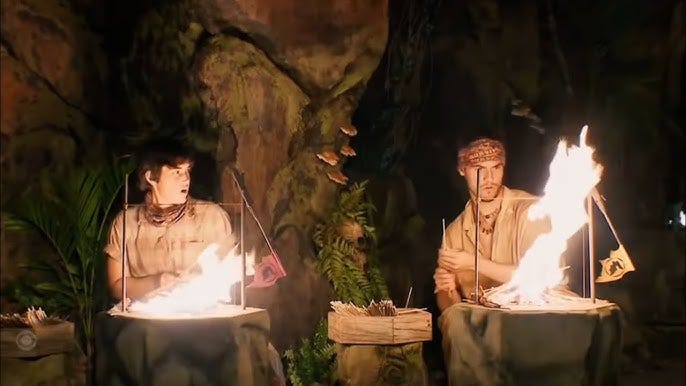
When the wind unexpectedly picks up
To continue the fire-making analogy from last week’s post on how to extend and deepen whole-class conversations in the classroom, I remain more interested not in the summoning of those initial sparks but rather the dance that takes place in coaxing a fire to full life.
One of the somewhat-controversial additions to Survivor of late has been a mandatory fire-making challenge when contestants reach the final four. Setting aside the in-the-weeds gameplay debate on this topic, the good thing about these fire-making challenges is that they quite-often deliver great television—especially when an inconvenient wind happens to pick up and send best laid plans awry (see above).
For teachers trying to facilitate those conversations in the classroom, I imagine this “inconvenient wind” feels familiar.
The whole-class conversation starts off in a promising direction, with a few spot-on initial comments, only to ebb or fade unexpectedly—and there you are with a choice: abandon the potential you thought you saw or, if you’re willing, to reach into your tool belt and try to find the right maneuver to poke and prod that “fire” back to life.
Today’s post? Three more “moves” I use when I see the conversations losing steam or getting a bit off course—though in today’s post, I feel compelled to note that all of these have a bit of risk involved. Whereas the three strategies I covered in last week’s post are quite reliable no matter the context, each of these three come with a downside that deserves acknowledgment, too.
(Along with a concluding wondering, too, about how to arrive at authentic whole-class conversation amidst all these intentional and produced moves as a teacher?)
Move ⓸ - The Straw Man Follow-up
This is definitely a know your students move, as it involves you pushing back on a response with a deliberate misrepresentation of what the student said. While that does not seem like a wise move on surface, I’ve found that it not only can push the individual responder to a better and deeper answer—it also can enlist the rest of the class in that thinking, too.
An Example of this Move: Shifting away from my juniors and the King Lear examples from last week’s post, I’ll pivot to my sophomores and their current unit researching technology and AI.
Following the Super Bowl, one of our bellringer discussions was centered around the now-infamous Ring commercial—and after individual reflections and brief group conversations, students shared out whole-class whether they had a positive or negative reaction to the commercial.
“I definitely don’t like it,” one student said, pointing out their skepticism about the surveillance capacity it being misused for harmful purposes. (Valid skepticism, I’d add!)
“So what you’re saying,” I then said, knowing at this point in the school year that this was a student who’d be 100% willing to push back, “is that you do not care at all about saving lost dogs.”
Almost immediately, the student jumped right back to add clarification, but here’s the more important thing: several other hands shot up as well. Now it was “the class against Mr. Luther,” and a conversation that initially was relatively placid was injected with energy alongside renewed purpose.
Mission accomplished.
Tips For Using This Move:
As is the case with the other moves in this post, I’d wait on this until you know your students well enough to push back one their answer in front of others—one of the reasons I use this much more in the second semester of the school year!
Another important thing is that you make your intentional misrepresentation pretty obvious, as you want the rest of the room to pick up on it! (An overt tone change or even a little smirk can help here.)
To use a bowling analogy, the real 7-10 split with this move is to find a way to wield it in multiple directions within a conversation—not easy to do, but a pretty fun dynamic on the rare occasions you get there.
Move ⓹ - Synthesize-and-Rank
In facilitating whole-class conversations, sometimes I think the most important thing you can do is recognize when too many points are on the table.
When I begin to sense this dynamic, I’ve found that it is helpful to (a) synthesize the main points that have been raised so far, often combining multiple student answers and (b) then ask groups to vote on or rank which they find to be most convincing or important.
An Example of This Move: Let’s take the same Ring doorbell commercial and pretend it went another route, with students listing several potential benefits of having more surveillance built into homes across the country.
“Okay, so let me recap what I’m hearing so far,” I could say, pausing this hypothetical version of the discussion. “Several of you think the surveillance could be helpful in emergency situations, others point out that it would deter crime from happening in the first place, and finally there was that one point about the sense of safety and security knowing that you have a system like that in place.”
After recapping, I could then hop onto the lesson’s slide deck projected at the front of the room and briefly type up my recaps (Point A, B and C) and ask each group to rank the points before sharing out—including a rationale for their top choice.
And then dive back into this reinvigorated discussion whole-class.
Tips For Using This Move:
Especially earlier in the year, it works much better if you can avoid relying on individual student answers (“Which point is better: Andrea’s, Jose’s, or Andrew’s?”) and instead combine them to avoid any student feeling as if their idea or perspective was invalidated by the rest of the class.
After you recap/synthesize the conversation, make sure to ask if you missed anything—a helpful question for them as well as you!
Combining this with an individual quick write is also really effective, especially mid-discussion (“Write down your top choice and a one-sentence reason before you vote as a group. No talking yet!”), as students get to entrench a bit more into their personal take first before group debriefs begin.
Move ⓺ - The Student Hypothetical
Just like the Survivor fire-making challenge pictured at the beginning of the post, sometimes, for whatever reason, a conversation that had life begins to die down—and something has to be done.
Finding an opportune student hypothetical is one of my go-to’s in these moments.
While this definitely is experienced more as an interruption to a whole-class discussion, I still lean on it from time to time in order to shift thinking and, more importantly, inject a different type of energy.
An Example of This Move: I’ll stay once more with the original Ring doorbell conversation, only a bit later on after lots of different points had been raised about whether or not it was a good idea to use the surveillance tool as a means of locating lost dogs.
“Okay, I hear all your points,” I said, sensing the conversation beginning to ebb. “Let me give a different example.”
A pause.
“Let’s pretend that [insert name] is a notorious mailbox vandal,” I said, pointing in the direction of an intentionally-selected student. “Like, we’re talking, a no-mailbox-is-safe-in-the-vicinity-of-[insert name]. You get what I’m talking about?”
Some smiles around the room, including from [insert name], and then I went on to ask if we were okay using that same technology to finally apprehend [insert name] after all of their mailbox crimes—and from that point the conversation jumped forward, now with an entirely different framing as far as the use of surveillance for hypothetical human crimes.
A shift in the conversation, yes, but also one that was rebuilt with more fuel to sustain itself going forward.
Tips For Using This Move:
I think it goes without saying: you have to know your classroom well enough to know who is the right choice for a given hypothetical—high upside, yes, but also an obvious downside.
I’ll admit that this is one I sometimes plan out in advance in preparing for a discussion, based on how it goes. Or what happens more often: I find a great hypothetical opportunity in one discussion and then I’ll use it again in later classes in similar conversations. (Sometimes even in future years!)
The trick with this one? Lean into the fun of it. Use yourself as an example at times, too! (“So you’d be okay getting Mr. Luther arrested for just a little mailbox vandalism? How many of you even know where a postage stamp goes on an envelope?”) It’s not just okay to have fun in the classroom—I’d argue, rather, that it is necessary. Now more than ever.
One More Thing: What About “Cold Calling”?
Given that I’ve spent two posts in a row considering strategies for whole-class conversation, I went ahead and added a reflection about cold calling in the video above—as without question, this is something teachers should be reflecting on when it comes to the way they facilitate conversation in the classroom.
I go into the following points at length in the video, but here are is a quick summation of the three things that are top-of-mind for me when it comes to cold-calling:
It doesn’t actually have to be “cold.” Whether students have a chance to write their ideas down first, share with a partner or small group first (or you sneakily ask them for permission before “cold calling” on them whole-class!) there are many ways to make this more positive and welcoming for all students.
Want to be a “cold calling” teacher? Plan backwards. Think about what your vision is of a classroom that lives and breathes positively with cold-calling: what does that actually look like for all students? And what steps do you need to take to get there as a classroom community?
Cold calling poorly is the worst scenario—which is why you need to be mindful of your own capacity as a teacher before leaning into this practice. Choosing the right questions, being prepared for a range of responses, and knowing your students? All important prerequisites.
…but when and how do you arrive at authenticity?
One of the easiest things to do at the end of a post like this—in which I’ve laid out several strategies that work well in my classroom—is to tie them up neatly with a bow by reflecting on the impact they can have.
And then send it on its way out into the world.
To be clear: I’ve concluded this way many times with posts on The Broken Copier, and likely will continue to fall into that pattern going forward quite often.
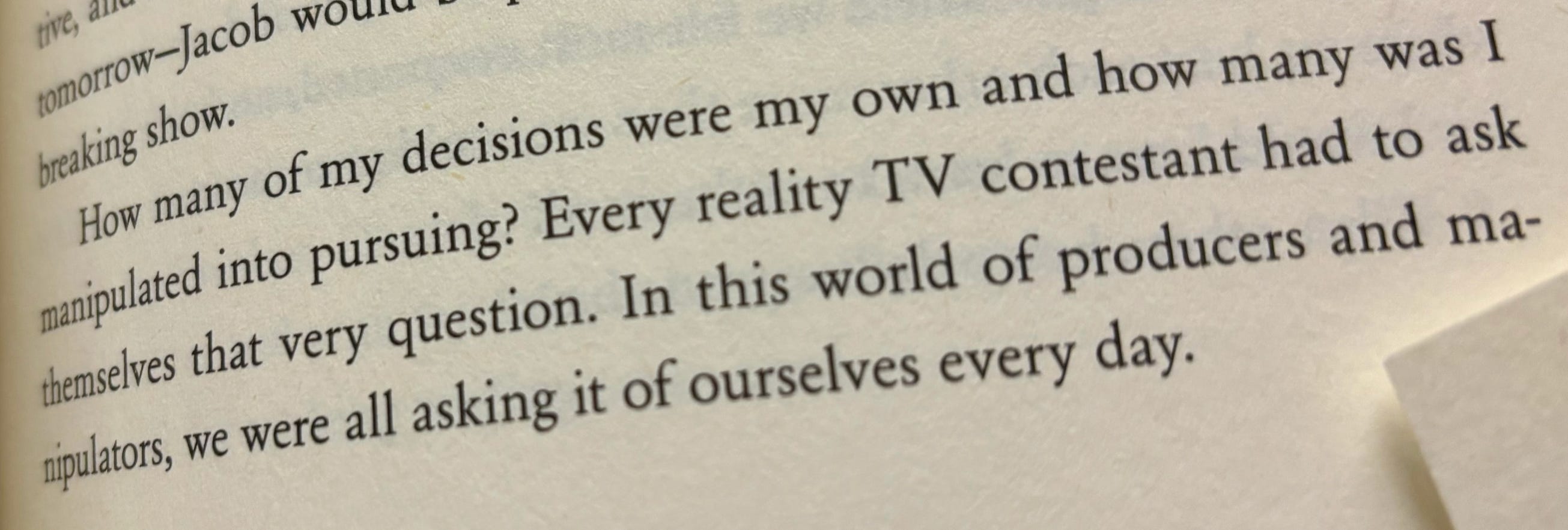
Yet with today’s post, I want to briefly interrupt that tempting, easier closure to instead pivot back to the opening of this post with Fishbach’s novel Escape! and the contemplation many of its characters stranded within the world of reality television arrive at by the end:
“How many of my decisions were my own and how many was I manipulated into pursuing?”
One of my own wonderings amidst laying out all these impactful, effective strategies—seriously, I use them all the time and believe deeply in what they can do for a classroom!—feels very much in parallel to the characters in Fishbach’s novel:
Is there a downside to doing so much to design for whole-class conversation and facilitate it with a particular vision of how you hope it will go?
In other words, what makes me that different than those reality television producers crafting their narratives by poking and prodding the conversation tactfully? And what is lost in doing so much deliberate work as a teacher to not only make whole-class discussions like this happen but to keep them going—often further than they would have naturally gone?
I don’t know the answer to this. (I think it’s important to say that!)
I do know the positive impact that they can have on students individually and collectively, and I believe in it enough to write posts like this! But one of the worst parts of our education discourse, I think, is our refusal to transparently contemplate the downsides of our practices, even the practices we believe with conviction are good for the classroom.
Despite all the good I’ve seen happen as a result of these strategies, particularly as far as the number of students who are joining the conversation more frequently as the year goes on, there is still that word that lingers in my wonderings: authenticity.
In the same way that I want students to be able to write in their own authentic voice beyond a predetermined structure, I very much want students to find their way to their own meaningful conversations beyond my designs for the classroom.
That’s what we need more than ever, right?
How to get there, though, is a conundrum to me still, and certainly a real potential downside of this much intentional facilitation as a teacher around whole-class conversations.
There is no such thing as a destination in this work of teaching. Which is why I love this work so much and also why I love sharing it with others so I can continue learning and growing.
Consequently, please feel free to share your own ideas and feedback on this in the comments!
What strategies work for you when you feel those conversations ebbing—do you have any “riskier” moves like those shared here?
Thoughts on cold-calling? (I could definitely see that being a longer post or conversation in the future, too.)
Finally, where does “authenticity” fit into all of this?
(Also, feel free to toss any predictions for Season 50 of Survivor into the comments, too, if you want! I’ve got Coach and Dee at the top of my fantasy draft board, and hopefully they at least make it through the first boot tonight!)
Three Posts To Keep Exploring
I literally ran out of post length last week and didn’t get a chance to include more readings from other writers that I value—but thankfully I took note of that limit ahead of time with this one. These are three posts that I genuinely enjoyed recently and, in my thinking, stretch the ideas of today’s post even further:
The Power of Silent Discussions for Deeper Collaboration by John Spencer: while very different than the vision outlined in my own two-post series here, Spencer lays out a “discussion” approach via silent student writing that I’ve used before and very much found fruitful. Definitely worth taking a look at!
It Takes Ten Years to Grow a Teacher by Matt Brady: “Around year ten, instinct replaced uncertainty,” Brady writes. I concur: it takes considerable time for teachers to reach a place of expertise—including with facilitating whole-class conversation—yet the system is not designed for teachers to get there nearly as often as we need them to.
The Sublime, Revisited by Yom Fox: This post I came across yesterday resonated with me deeply, as it was a reminder of how necessary it is to aspire for the sublime—through art as well as conversation: “Because the arts do something schools and systems often struggle to do: they hold complexity without rushing to resolve it.”
I am an educator who, during grad school (early 2000s), fell in love with Lesson Study as both a professional development model and a way to thoughtfully design lessons that maximize student participation. Over the last 20+ years, I’ve used that same approach: I focus on creating the conditions for students to show up as they are ready and able to participate.
Not every class will look as though I’m engaging everyone—and teachers, in my opinion, are often not great at discerning real engagement in the moment. Very few teachers shift their metric (whether formally written or simply held in mind) for what engagement looks like from lesson to lesson.
I actually value silence in the classroom. I also know I’m working with—and sometimes against—the adolescent brain (primarily as a high school educator). I often name my expectations at the start of class and use a range of strategies to draw students into discussion, including cold calling, having students popcorn call, having students use "talking pieces" for participation, or just seeing what happens. I have always let students know ahead of time, though, so it never feels like a “gotchya.”
For me, authenticity means modeling what is genuinely true: I am an educator who loves teaching and… doesn’t particularly enjoy public speaking. Naming that honestly has helped me create spaces that feel both structured and student/human centered.
I empathize with the tension between design and leaning towards the originality/genius/spontaneity that inherently IS %-more student-driven (over %-more teacher-designed) discussion. I always lean towards teacher-design because I care (too much) about hitting the objective. I miss a lot as a result -- and I am not sure how to resolve for this. I hear about other discussions happening when other English teachers are talking, and I worry I over-design a lot... there are costs. I do a HUGE variety of discussion models to compensate / balance, but all of those are pretty teacher-objective/ minutes-on-the-clock driven. I worry about what I lose in hitting other priorities. This is a great post, as always. I really appreciate everything you do.