


I have an unusual way of taking notes.
“Sketch notes” is probably the wrong term for it—or at least a vast overstatement of what actually takes place in my journal when sitting in a professional development session—but I admittedly have my own style, you could say.
Particularities aside, a few rules of thumb I have found myself adhering to: [a] always start in the center because, why not? [b] always carry multiple colors of pens and be ready to make lots of arrows; and [c] always add a “takeaway” space to capture my most important thinking whenever the session or presentation ends.
Too much information? Perhaps.
But it feels like a necessary preamble to this post, as ever since returning from the Humans First: Adolescent Education in the Age of AI Conference at the end of July, I’ve found myself returning to my notes, appreciating the myriad conversations and reflections that took place in Atlanta, and then imagining forward—within my own classroom and beyond it.
On the airplane flying out to the conference, I had tried to capture the things most on my mind before the conference even started:
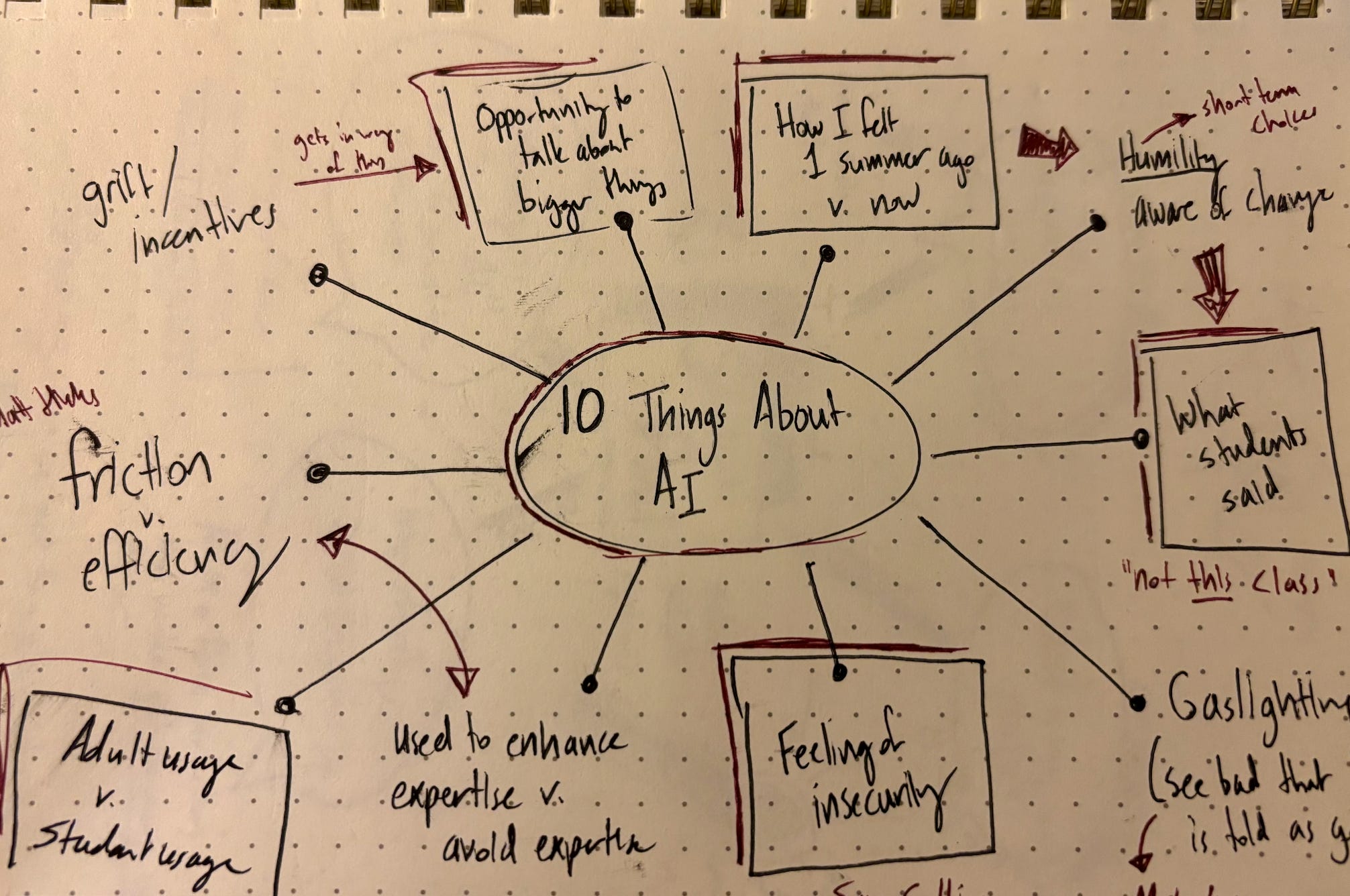
The toddler seated next to me on the airplane definitely gave me a side-eye or two while I was scrawling these anticipatory notes, almost as if I was disappointing them by not adhering to a more-formal Cornell Notes style.
By the time I was flying back, however, my journal was filled to the brim with odd note-taking formations—the best possible visualization of what my mind felt like after a tremendous experience that had my mind spinning in all sorts of ways.
Today’s post is my best attempt to capture where I’m at with AI as I step into this new school year, with four broader “takeaways” that arose for me in returning to my notes from what was a remarkable conference experience—with some snapshots of those notes included!
(Just please don’t judge me as much as that random toddler I was seated next to on the flight!)
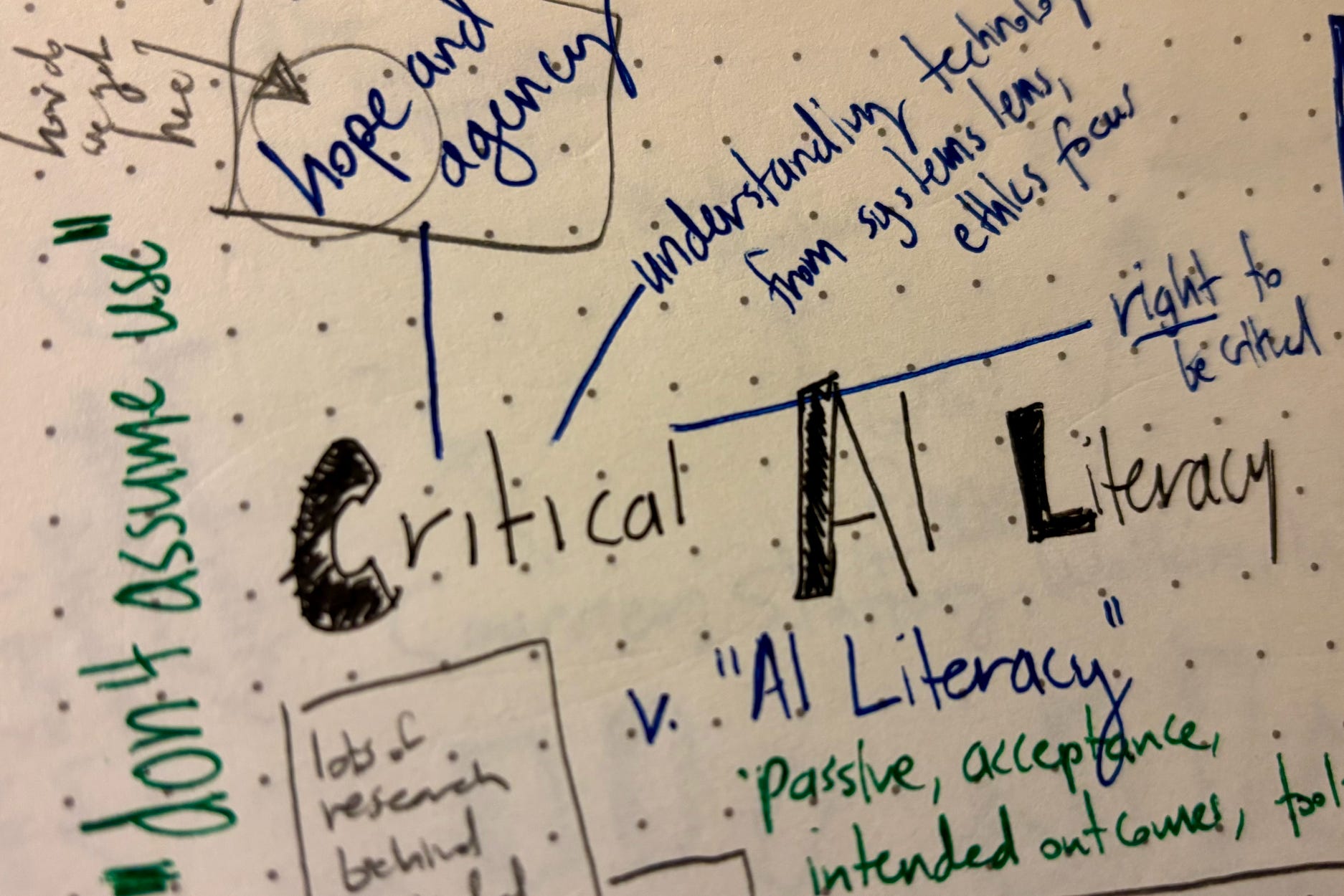
⓵ We Need More/Better Critical AI Literacy
One of my favorite conversations around AI this summer actually took place prior to the Humans First conference in Atlanta: when I had the chance to interview Mike Taubman about the AI Literacy elective he designed and facilitated for his school. After reading so much about that journey on his own Substack, this conversation cemented for me how much potential value there was in bringing AI Literacy into our classrooms.
Then I got to the Humans First conference and sat down for the opening keynote: a presentation on Critical AI Literacy by Katie (Kathryn) Conrad and Sean Kamperman.
Immediately it was clear why this was the keynote, as it set the tone for the conference and, at least for me, offered a breath of fresh air against so much else of what I had read and heard around AI in education to this point.
Two points that resonated deeply with me:
There is a difference between a version of (1) an AI Literacy that implicitly suggests passive acceptance of the current trajectory and presumes inevitability of what AI’s implementation will look like versus (2) a Critical AI Literacy that holds a system lens and ethics focus, treating AI like a text to be understood rather than just a tool to be learned. Unquestionably, the latter is the way.
It is powerful to avoid the “checklist disclosure” that too often shows up in AI presentations and conversations: a quick acknowledgment of critiques without spending any time actually sitting with and considering them. Conrad and Kamperman instead laid out various ethical critiques in depth, each accompanied by thoughtful and ample research, and also resisted the temptation provide answers of what “going forward” will look like. At least for me, holding a critical uncertainty at this moment is quite preferable to the “inevitability” narrative.
Sitting in the auditorium for this keynote, I felt a conviction deepening in me: students and teachers alike need and deserve this version of AI Literacy—one that makes space for criticism and authentically speaks to the reservations many AI proponents have tried to speed past or ignore entirely in recent years.
How is this going to show up in my space? I’ve already started drafting out a mini “Critical AI Literacy” sequence that brings together so much of what I’ve learned this summer, and I feel not only as convicted as ever but more importantly as equipped as ever to design better conversations in my own classroom around AI.
(And of course, as always, I’ll make sure share out how these conversations go!)
⓶ We Also Need To Hold Onto Humility
Probably one of the most linked-to writers on The Broken Copier over the past few years has been Marc Watkins, so it should be no surprise that his presentation was one that left me thinking deeply about what is in store for us moving forward.
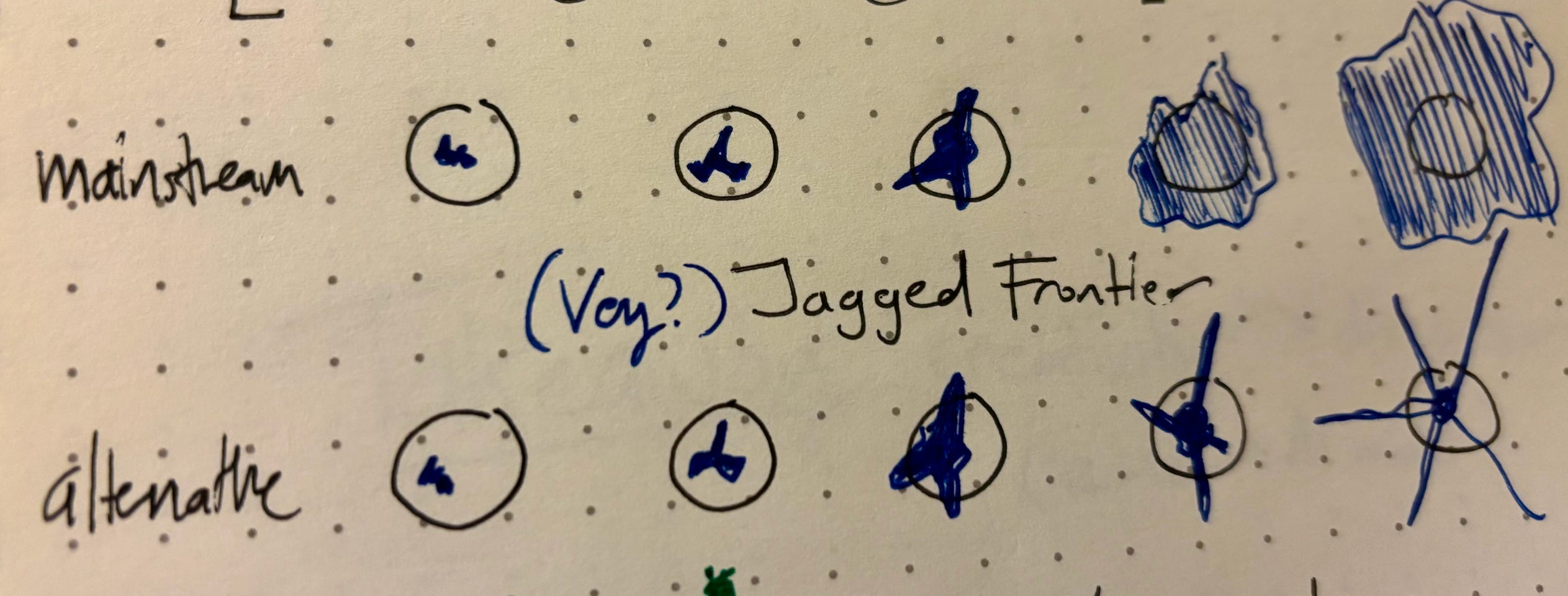
In his presentation he shared a visual originally from Adam Hunt—which he also referenced in his own post this week—he pointed out how unpredictable AI’s development has already been and likely will continue to be, readily surpassing human capacities in certain areas but stubbornly confronting walls in others. (You can see my own scribbled rendering above!)
We need to be humble about what we know about AI and its impact right now, yes, but even more so about what the next 3-5 years will look like—not to mention anything further down the road.
At the same time, one of the things that I appreciate most about Marc’s writing is how much work he has done to develop AI fluency—holding his own form of Critical AI Literacy but also exploring the possibilities of what AI can mean in the work of design and instruction for educators.
Humility cuts both directions, I was reminded, and I found myself motivated to remain curious and keep learning, with humility as a call to action rather than a removal of myself from the conversation.
How is this going to show up in my space? I will continue to commit to humility in my own messaging around AI and technology—with students and families as well as with colleagues. Given the current landscape of substantial differences in opinion that seem to be getting further apart rather than moving towards any type of consensus, maintaining a firm grasp on our own humility in a way that propels curiosity and conversation?
That’s something worth committing to, I believe.


⓷ Clarity of Purpose Matters More Than Ever
In our Broken Copier conversation leading up to the Humans First conference, Samantha St Lawrence Collins said something that has sort of lived in my head ever since:
…But what I think has been wonderful is that, you know, regardless of how people feel about AI, it has, for me at least, introduced an opportunity for people to talk or return to, I think, what we want humanities instruction to look like. It has required a sharpening and articulation of our goals and conversations with college writing teachers that I’ve never been able to have before. And those are inherently valuable, whether or not we’re talking about AI or or not.
In a way, Samantha Collins reframed what has been experienced by most of us as a burden instead as a type of opportunity: an opening to talk with humility and curiosity about what our path will be going forward—and to talk with those we likely never would have had conversations with otherwise.
I kept thinking about this throughout the conference, not just during sessions but especially in those “in between times” when the conversations continued over lunch, grabbing an evening drink, and even riding MARTA back to the airport.
There was zero chance I’d be having these conversations if it wasn’t for the disruption that AI has enacted upon all of our work.
For that, I’m grateful—and I also realize that the task moving forward is one of articulation, in that it is incumbent upon us in education to be clearer and more convicted than ever in conveying the purpose of the work of humanities that takes place in our classroom.
How is this going to show up in my own space? I was already motivated after conversations with Christian Moore-Anderson and Angela Stockman earlier this summer to lean into a more-authentic why around the what that takes place in our classroom—especially in terms of how I invite students to reflect and participate in the meaning-making themselves—and this conference reaffirmed this priority.
This is not just an “AI thing,” either, but a broader need to articulate the meaning of our work with clarity and confidence. Which is a good thing, I think.
⓸ Clarity of Costs Matters, Too
There were many aspects of the design of this conference that I appreciated, particularly in retrospect, but perhaps none more than the choice to open the entire conference—even before the “opening keynote”—with a student panel.
There Michael Burns was, standing on the stage with three students from his school that was hosting the conference, asking them questions about their own journeys with AI and what their individual experiences had led them to understand at this point in their high school journey.
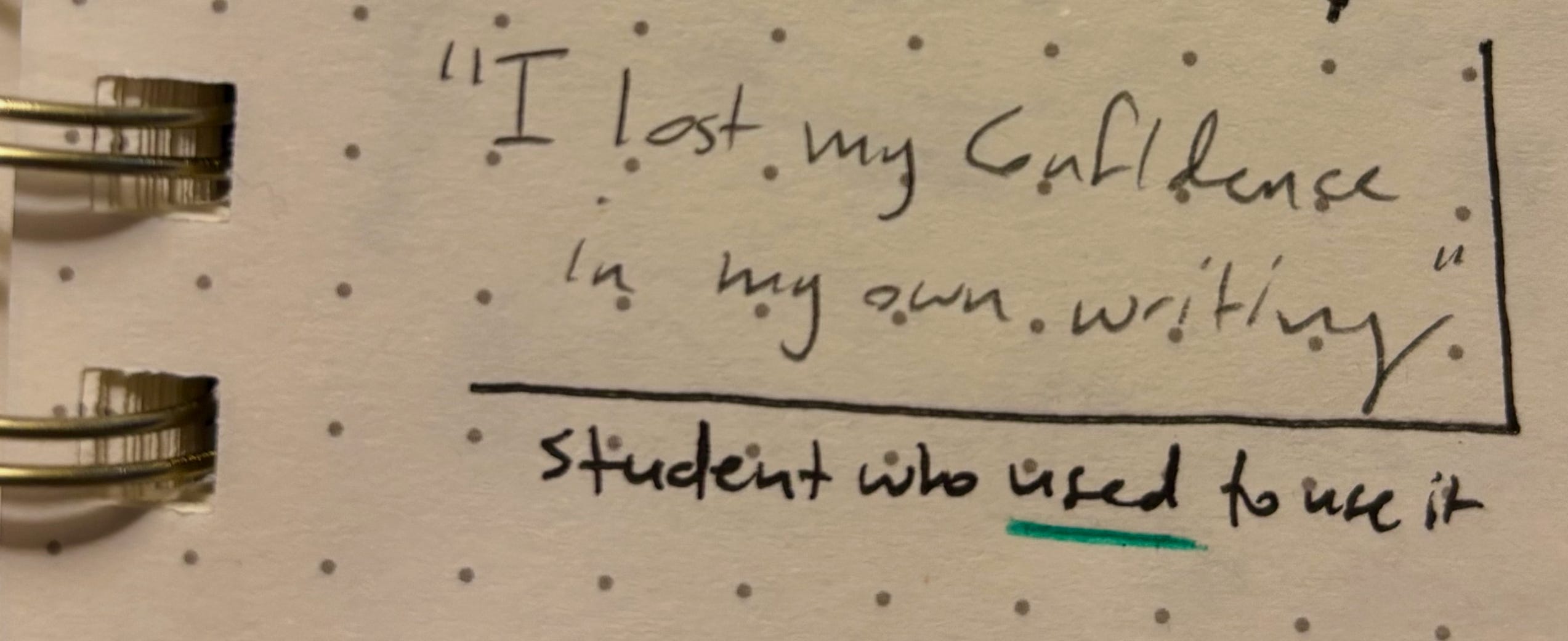
All of the students had insightful, varying perspectives to share, but there was an admission from one student that I don’t think I’ll ever forget: a student who shared how they previously had used AI as a tool in their learning quite frequently but had essentially decided to reverse course and avoid it altogether in their learning.
In explaining what led to this decision, this is what they said:
“I lost my confidence in my own writing.”
You could immediately feel these words immediately sink into everyone listening.
In trying to keep up with their peers and set them themselves up for future success, this student acknowledged how they had felt “pressured towards AI” and that they had found themself prioritizing outcomes like grades more than the learning itself.
The most inspiring part about this, I believe, was this student’s remarkable self-awareness and change of direction to honor their own learning (educators: we can take a page from this!) but it also served as a clear, undeniable reminder to me of the costs of the current choices we are making in the education landscape.
That students are recognizing these AI tools are not good for their learning but still are choosing to use them should serve as a red alert about the signals we are sending within our classrooms and schools. Students are responding to conditions we create for them—and at some point we need to take responsibility for those conditions, right?
How is this going to show up in my own space? This was yet another confirmation of the message my students once again shared with me at the end of this past school year: it could be valuable to learn about AI, but not to the detriment of the learning in our classroom. So while I remain committed towards humility and curiosity, I am just as confident for now in my own choice to avoid bringing AI as a tool into our classroom. The costs are simply not worth it.
My Final “Takeaway”: We Need More Conversations
Perhaps an example-by-design aspect of this conference, too, were the various panels that placed teachers and educators with different perspectives on the stage—panels that were then paired with “homeroom debriefs,” where attendees would meet together afterwards to talk about what they took away from the sessions and panels.
In my experience, far too often “education conferences” bring together lots of different teachers and educators, plop them in a room, and have one person talk at the entire audience for a set amount of time—only to rinse/repeat that format again and again, until the conference ends and everyone goes back to their own respective spaces.
Reflecting on this very-different conference experience on the flight back from Atlanta, I found myself buoyed, in a way—not just with the understandings I took away around AI and education but even more so by the value of the conversations themselves.
And a recognition that we need more of them.
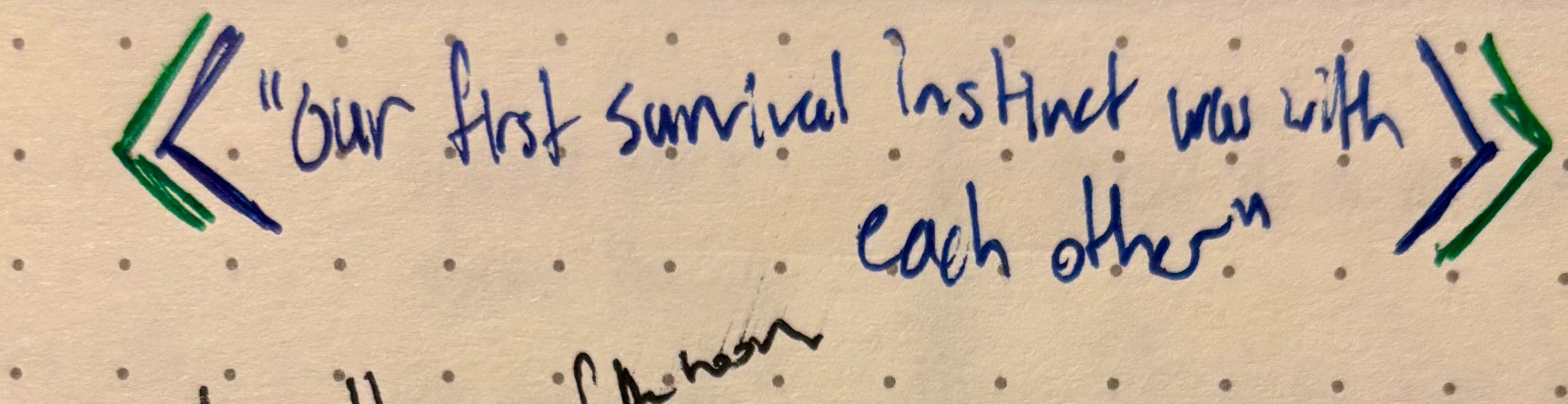
In one of these aforementioned panels, Matt Hicks shared a quote that immediately found its way into my own journal:
“Our first survival instinct was with each other.”
Stepping into a new school year that inevitably will bring more challenges, around AI as well as myriad challenges beyond AI, I think it’s fair to predict that the Sisyphean nature of education’s problems outpacing its solutions will continue on, regardless of our context.
We don’t need to push that boulder up the hill alone, though.
So we shouldn’t.
August always seems to be a month where there is a wealth of incredible things to read in education from thoughtful writers, and thus far August 2026 has been no exception to that! Here are five different pieces that resonated with me in some way over the past week that I believe are worth checking out:
Extrinsic Education Was Always the Problem by Stephen Fitzpatrick – So many aspects of this piece were meaningful to me: the opening anecdote around not receiving a grade until after finishing the degree; the Mihaly Csikszentmihalyi work around “flow”; and this question: “If a teacher is not sincerely interested and invested in their subject matter, why should their students be?”
We have a school culture crisis by Andrea Castellano – If a pair of sentences was going to sit with you this week, it very well might be this one: “We’re so far from our mission statements. We’re so far from real teaching & learning.”
Does Education Really Require the F-Word? by Jon Ippolito – I have frequently uplifted the word friction as an 100% good in education, but Ippolito here complicates this word in our work, and, in a good way, complicates the work itself. (Which deserves this complexity!)
Education’s Impatience with Thinking by Alex McTaggart – Sometimes you come across a piece that demands you sit with it, and for me this was the one this week: “Problems become things upon which somebody should be able to act, while some of the most important questions in education resist that treatment.”
I’m Ambivalent About “The Science of Learning” by Dylan Kane – Of course, I recently had the pleasure to chat with Dylan on a Broken Copier episode, but this piece? It made me want to hop right back on and pick his brain about Science of Learning—because I found myself nodding throughout my reading of this piece.
"I am just as confident for now in my own choice to avoid bringing AI as a tool into our classroom. The costs are simply not worth it." Amen to this 👏
Love your sketch notes! Why the heck don’t I take notes like this? I’m going to now! (I’ve always been a mediocre notetaker. I wish I had you as a teacher!)
I am honored to show up in this reflection given what a jam-packed and amazing gathering it was - including your great and thought provoking session that I’m totally stealing ideas from. It was really a fantastic couple of days, wasn’t it? Kudos to Mike and the team!
I just started to write a bunch of points of agreement and have deleted two paragraphs that I think can just be summarized with “what he said.” 👆
(And I was working on the collaborative workshop collage zine last night. Coming soon!)